
Updated JJulyuly 33, 2026
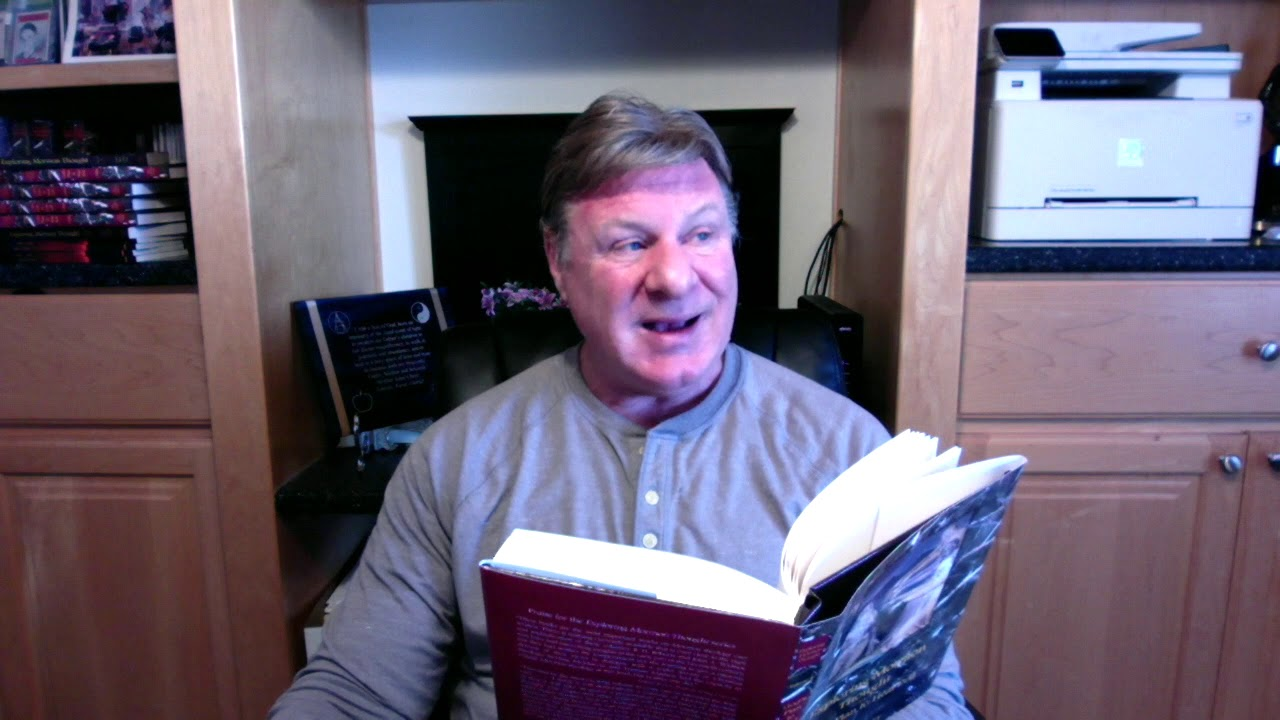
Blake T. Ostler is a popular scholar in LDS apologetics. He is best known for his “Exploring Mormon Thought” series, comprising four volumes published between 2001 and 2019—The Attributes of God, The Problems of Theism and the Love of God, Of God and Gods, and God’s Plan to Heal Evil.1 He has also published articles in Dialogue, Sunstone, and BYU Studies.
McMurrin interview

His early role in Latter-day Saint intellectual circles intersected with the fate of the Seventh East Press, an independent student newspaper at Brigham Young University. Ostler writes,
“I fell in with a tough crowd at BYU who published the 7th East Press. I did the interview with Sterling McMurrin that got it kicked off of campus. I was well on my way to being a Maverick.”2
The paper ceased operations in early 1983 after a campus sales ban was enacted on February 11, 1983,3 sparked by Ostler’s January 11, 1983, interview with Sterling M. McMurrin, who challenged the Book of Mormon’s authenticity.4
Non-standard views
Ostler has drawn attention in some LDS circles for his controversial views, particularly his expansionist approach to the Book of Mormon,5 his rejection of a regress of gods, and his denial of God’s foreknowledge of human choices. He also rejects pre-mortal spirit birth,6 refutes common arguments for a Heavenly Mother, and offers non-standard interpretations of the King Follett Discourse and the Sermon in the Grove.7 Additionally, he teaches an emergent social trinitarianism, asserting that the Godhead eternally emerges as an accidental rather than ontological relational unity.8
Divergence from prophets and apostles
Ostler realized early that,
“The way that some… Church leaders saw the Church was not going to be something that worked for me… I was going to have to find my own path.”9
He summarizes this as a defining characteristic: “In some ways, this became kind of the very impetus for who I am and what I am.”10
The reader is invited to decide whether Ostler has a dismissive attitude toward LDS prophets and apostles in the examples below. This includes his:
- categorizing Brigham Young’s theology as “a disaster for the most part”
- rejecting Dallin H. Oaks’ statement about Heavenly parents as “simply false”
- correcting Neal A. Maxwell on divine timelessness
- denigrating the 8th Article of Faith
- calling for more “sacred silence” over Heavenly Mother than even LDS prophets exercise
- denying that Heavenly Mother is doctrine
- rejecting the dominant reception history and downstream theology of the King Follett Discourse by prophets and apostles
- rejecting all major post-1845 LDS prophetic and apostolic views of spirit birth
- claiming that the Family Proclamation is “not doctrine”
- describing the First-Presidency-vetted Gospel Topics Essays as “embarrassing”
To the chagrin of other Latter-day Saints, and to the delight of others, Ostler seems to diverge on “a question of ontology that has its roots in doctrinal teaching in an unbroken chain back to the Prophet Joseph Smith.”11
“I was going to have to find my own path.”

“Joseph Fielding Smith had a kind of neat syllogism—actually it was a reductio ad absurdum:
“If there is no Fall, then there’s no need for atonement.
If there is no need for atonement, there’s no need for Christ.
And if there’s no need for Christ, then everything’s false.“Which of course, you know, I saw through that, you know, kind of reasoning fairly quickly. But it seemed to me that I was going to have to confront head-on the fact that the way that some of Church leaders saw the Church was not going to be something that worked for me. And that I was going to have to find my own path.
“In some ways, this became kind of the very impetus for who I am and what I am.”12
Brigham Young’s theology “was a disaster for the most part” and “was not a good theologian.”

“I personally believe that [Brigham Young’s] theology was a disaster for the most part and though I like his emphasis on God as a person and not merely a title or essence as the basis of our worship.”13
Upset over being thus quoted, Ostler objects:
“Mormonism Research Ministry[,] you simply misrepresent at every turn – and on purpose. Yes I stated that BY was not a good theologian. But you purposely leave out that I went on to state that prophets don’t need to be and it is better if they are not theologians. None if the prophets of Israel or in the NT do theology in the proper sense inspired by Greek philosophy. I stated that BY’s real calling as prophet was to lead the Saints westward and that only one like BY could do it. But you left that out because you are a dishonest grifter having no care for the truth.”14
In another thread he repeats:
“Prophets don’t need to be and it is better that they are not theologians because they lead by revelation and not trying to figure things out. I stated in no uncertain terms that: (1) BY was the inspired and right leader for the time because the LDS church needed the kind of clarity and forcefulness that BY exhibited; and (2) BY was a prophet who didn’t need to engage in theology because that was not his calling.”15
“The chain of gods is tied up in [Brigham Young’s] Adam-God theology.”
“While Joseph Smith did not have such a view of an eternal chain of gods, it appears to me that Brigham Young did. However, it seems to me that his view of the chain of gods is tied up in his Adam-God theology and ought to be rejected as unsound doctrine by Latter-day Saints.”16
Statement by Dallin H. Oaks about Heavenly Parents is “simply f7alse”

Corey Ostler asks,17
“Are you saying that you would agree with the statements that, let’s say, Elder Oaks has made—I’ll cite someone specific —that says, ‘Our theology begins and ends with heavenly parents.’”18
Blake Ostler responds,
“That’s simply false.”
Corey:
“Okay, so you disagree with something that a leader would believe. That’s what I’m just saying.”
Blake:
“Our theology begins and ends with the fact that we are eternal beings uncreate and of the same kind of being as God.”
Correcting Neal A. Maxwell on divine timelessness

“Neal A. Maxwell of the Quorum of the Twelve Apostles, writes, ‘The past, present, and future are before God simultaneously. . . . Therefore, God’s omniscience is not solely a function of prolonged and discerning familiarity with us—but of the stunning reality that the past, present, and future are part of an ‘eternal now’ with God’ (italics in original). The idea of God’s eternity here appears to consist not in the Hebrew notion of God’s eternal duration in time without beginning or end; but of transcendence of temporal succession. In fairness to Elder Maxwell, we must recognize that his observations are meant as rhetorical expressions to inspire worship rather than as an exacting philosophical analysis of the idea of timelessness. Furthermore, in a private conversation in January 1984, Elder Maxwell told me that he is unfamiliar with the classical idea of timelessness and the problems it entails. His intent was not to convey the idea that God transcends temporal succession, but ‘to help us trust in God’s perspectives, and not to be too constrained by our own provincial perceptions while we are in this mortal cocoon.’”19
“What happened is that Truman arranged for me to meet with Neal Maxwell after I had written a paper about divine timelessness for a class. After Truman read it he told me that I had expressed it better than he thought he could (that sounds arrogant to say, but that is what he said) and he asked me to go discuss the issue with “Neal” because they had discussed the issue and he had never been able to convince “Neal” that timelessness would not work. I met with Elder Maxwell and explained why timelessness may work for Boethius who he had quoted, but not for Joseph Smith. I explained why I thought that the idea of timelessness per se was incoherent and contrary to scripture. I explained why, from my POV and the historical context, the statement about God’s time being one eternal now did not mean what he had quoted it to mean. After our discussion Elder Maxwell stated that he had not understood how the idea interacted in different theological systems and how it would work for Boethius but not for a God who had a body. He asked me to publish a footnote about our discussion as a way of clarifying and clearing up the matter. That is what you see represented in this article.”20
Maxwell went on to publish in 1992:
“A word about those who, in their own minds, will not let God be God. They would have Him possessed of only fragmentary, inferential foreknowledge by being unable to see the future, thus qualifying His omniscience. No wonder King Benjamin pleaded with us to believe `that man doth not comprehend all the things which the Lord can comprehend’ (Mosiah 4:9).”21
Ostler concedes that Maxwell returned to his own opinion,
“I believe that after I published this article Elder Maxwell later returned to quoting the ‘eternal now’ quotation and D&C 130:7 about the past, present and future being ‘before God’ and God’s time being measured only to man to support a more or less classical idea of timelessness. None of these entail such a view IMO…”22
Ostler’s assumptions “contradict the clear teaching of the Brethren throughout this dispensation”3

BYU professor Stephen E. Robinson argues that the assumptions behind Ostler’s expansion theory of the Book of Mormon “contradict the clear teaching of the Brethren throughout this dispensation.” Accepting its claims eventually leads to passing the “authority in the Church… from the Brethren to the scholars.” If one looks to scholars like Ostler, but sees LDS leadership as “struggling under a false perspective and with archaic interpretations”, they “will ultimately abandon the idea of living prophets and turn to scholars for the ‘truth.’”23
An “intellectual Tower of Babel”
Daniel Evensen likens the philosophy of Ostler in Exploring Mormon Thought: Volume 4 to an “intellectual Tower of Babel”:
“Wouldn’t the average person expect a book on LDS philosophy (or ‘Mormon thought’) to contain frequent references to LDS scriptures and the words of modern-day prophets? Well, you won’t find that here. Instead, you’ll find a carefully constructed intellectual philosophical explanation of God, one that begins with certain fundamental assumptions, and then builds upwards, brick by brick, until it provides some sort of view over the whole of existence. I believe it was Truman Madsen who described such meticulously crafted philosophies as ‘intellectual Towers of Babel’…”24
The “8th Article of Faith… assumes way too much about the Bible’s correctness.”

“The 8th Article of Faith, in my view, assumes way too much about the Bible’s correctness and arguing about correct translation is, in my view, titling [sic] at windmills.”25
Higher criticism and pseudepigrapha
“Most of the OT wasn’t written by those whose names it bears. The Pentateuch wasn’t written by Moses. Isaiah didn’t write chapters 40-66. The gospels weren’t written by those whose names they bear. Many of the epistles attributes [sic] to Paul weren’t written by him. The Pentateuch is a pastiche of various traditions — often conflicting… Matthew’s injunctions on divorce contradict those found in Mark and Paul’s epistles. I could go on for awhile.”26
Joseph Smith “expanded” the Book of Mormon

“The model of revelation I propose here is that of creative co-participation. It seems to me that the Book of Mormon makes most sense if it is seen as both a revelation to Joseph Smith and as Joseph’s expansions of the text.”27
“What, then, may we conclude from the Book of Mormon’s use of modern sources? Only that the Book of Mormon as translated and presented by Joseph Smith relied on the KJV and was influenced by nineteenth-century American culture in rendering its me9ssage…
“It is possible that an ancient source contained on gold plates underlies the Book of Mormon, but Joseph Smith uses the KJV both for language and to clarify, expand, and interpret the thought of the original text.”28
1 Nephi 13-15
“1 Nephi 13-15 can be distinguished as Joseph Smith’s expansion through motif criticism. Its denunciations of the devil’s great and abominable church depend on Revelation and appears to express anti-Catholicism characteristic of nineteenth-century New York.”29
Mosiah 2-5
“A Christian expansion in Mosiah’s speech is detectable on form critical grounds. Mosiah 2-5 would appear to be reminiscent of a nineteenth-century camp/revival meeting on first reading (M. Thomas 1983). At a predetermined location where the people would sometimes camp in tents for several days, the revivalist would build a stage or stand (Mosiah 2:27) from which he would preach and call his audience to a sense of their awful guilt (3:19). Those who were convicted in sin would come forward crying, “What shall we do?” (4:1-2). They would be admonished to accept Christ (4:2-11). Many would experience a change of heart (5:1—4) and sometimes would fall to the ground as if dead or exhibit physical spasms.”30
Mosiah 15
Though the LDS Church dates Mosiah 15 to “about 148 B.C”, Ostler observes:
“Mosiah 15 thus attempts to answer theological questions that were asked only after the council of Nicea in A.D. 325, and the answer is premised on Anselm’s medieval satisfaction theory.”31
Alma 34:9-17 and 42:9-17
“The satisfaction theory of atonement elucidated in Alma 34:9-17 and 42:9-17 is a medieval theological development. The idea of atonement as necessary to satisfy two opposed but ontologically necessary attributes of God — his mercy and his justice — was first suggested by Anselm of Canterbury in his A.D. 1109 treatise, Cur Deus Homo? The satisfaction theory was premised on medieval concepts of law and justice and assumed that justice required full retribution for sin while mercy acquitted the sinner and did not require such penalties. The conflict in God’s nature could be resolved only by a sinless individual upon whom justice had no claim but who would allow justice to be done vicariously through his suffering. The suffering would have to come from one having both human and divine natures, however, because an infinite being had been offended by human sin, and only an “infinite atonement” could satisfy the demands of justice. Thus, Christ’s undeserved suffering provides infinite merit which can be dispensed vicariously to depraved creatures who stand in need of Christ’s grace. It is possible to detect influences of this theory in Alma’s presentation of God’s plan, which also shows Arminian influences in its description of vicarious sacrifice…”32
We haven’t found “one place or object that we can say with some certitude derives from Book of Mormon peoples”
“I have an article coming out in the next Sunstone where I suggest that we’re looking in all of the wrong places. Jacob states expressly in 2 Ne. 10 that the Nephites at least are on an isle of the sea. So I don’t accept any of the existing Book of Mormon geographies — though I definitely believe that the text of the BofM requires a limited geography of an area about the size of Palestine. In my view, there is not and cannot be any BofM archaeology until we find at least one place or object that we can say with some certitude derives from Book of Mormon peoples. We haven’t done so and so I suggest that we stop all of the non-sense about Book of Mormon tours and cruises.”33
Royal Skousen’s theory of tight control is “non-sensical”

“As for Skousen’s tight control theory of translation, it just cannot be squared with what we find in the text and real nature of translation. There is no such thing as isomorphic translation and it is evident to me that there is reflection in the text on KJV passages (which would have to be JS’s expansions). Further, I can’t see how looking at a ms. of the English translation tells us that there was a tight control with the original text (Skousen’s entire argument is non-sensical to me).”34
Undecided on NHM
“I am as yet undecided on the finds at Nahom in Arabia. The passage of the Pacific Ocean given currents and length of travel seems so highly improbable that it is not really a good candidate. As for islands – it may be that more than one island is referred to (the Book of Mormon refers to “isles” plural). I don’t know what Jacob meant by an “isle of the sea” (but he expressly states that they are on an isle of the sea)– but I see no reason that outlying areas like Belize wouldn’t work as well. I simply suggest that we keep open about the configuration since the narrow neck of land could be defined by large lakes as well as oceans or seas. So it could be a lot of different areas where there are two lakes that create a narrow neck of land between them (and that opens up a lot of possiblities [sic]). One thing I am clear about, the Mayan culture is a not a Book of Mormon culture.”35
How seer stones work
“Looking into the stone is a matter of silencing the mind by intensely focusing on the stone as a means of mediation, focusing attention on consciousness or awareness and opens a conduit of knowledge from the spirit in the process.”36
“The papyri that Joseph Smith possessed were not written by ‘Abraham’s own hand’”

“It is clear that the papyri that Joseph Smith possessed were not written by ‘Abraham’s own hand,’ because they date from around 200 B.C. to 100 A.D.—at least 1,500 years after Abraham lived. However, since I had experienced the truth of Joseph Smith’s calling as a prophet, I knew that I didn’t have to become an Egyptologist to retain my integrity. I still have questions about the Book of Abraham, but I have come to a few firm conclusions.”37
“Sacred silence” over Heavenly Mother; Asherah “is actually the notion of a temptress”
In a circa 2003/2004 Sunstone lecture, Blake answered a question regarding Heavenly Mother:
“I’m actually contemplating how I maintain the sacred silence by which I am bound. Some of us have very sacred experiences. I don’t deny the existence of a Mother in Heaven. But how could I discourse with you about her and what I know? And how could I say more without being disloyal to that relationship? If you want to know about her, I suggest that you know her. Don’t ask me about her. How could you know what experiences I’ve had and how I hold that? …
“We have no scripture about Mother in Heaven. Zero, zippo. The notion of an Asherah in the Old Testament is actually the notion of a temptress who tempts people away from the one true God.
“Second, I don’t believe that Joseph Smith ever taught the notion. I don’t believe he had the notion. I believe that what Eliza Snow said about Joseph Smith’s teaching the notion, she made up. It’s clear to me that during Joseph Smith’s lifetime, and I’ve researched this at great length, there simply are no statements that would indicate that anybody during that time period believed in a Mother in Heaven.
“The notion came from Eliza R. Snow. I believe that it became a cultural over-belief at that point…
“Now, with respect to the First Presidency statement, I believe that what we have to say about our Mother in Heaven is remarkably minimal. And I believe that to speak where we have no revelation is to misunderstand the nature of the discourse altogether.
“People have taken my silence about the Mother in Heaven to be a complete disregard. It is not. It is a very thoughtful decision on my part because of the relationships that I have. And I’m not going to go into it more than that, okay? …
“It would be like asking me what do you think of 16 minutes into the temple endowment and what they say there. I’m not going to discuss that either. That’s how I hold it. And so please don’t misconstrue this sacred silence.
“You would get the same response if you ask me, what did you do with your wife about 1:30 last night? Okay? I’d say it’s none of your darn business.
“And if you’ve got if you ask the question, you don’t understand what you’re asking. And so that’s the way I respond. And all I can ask you to do is respect that because I’m committed to it.
“But let me say this: There is a source of love and maternal acceptance that is beautiful beyond belief. And it is a part of our heritage and tradition. And it’s available for those who are willing to enter into their relationship. And I’ll leave it there.”38
“I deny that the mother in heaven is ‘doctrine’.”
In a March 6, 2021 thread on “Apologia of The Church of Jesus Christ of Latter-day Saints,” Alma G. asks,39
“What is the official stance on there even being a Mother in Heaven by the church at all? Does this have a basis in revelation, and scripture. Or is this all based on poems and church talks?”
Blake Ostler replies:
“Unless you are going to say that the 1909 and 1949 1st Presidency Statements giving reasons for denying the priesthood to blacks are doctrine; on pain of inconsistency you WILL have to say that the Family Proclamation also is not doctrine. Further, what IS the doctrine. That exalted resurrected beings having exalted bodies have sexual relations and give birth to spirits? Surely some analogical stance is required here. But if “parents” and “father” are given an analogical meaning, then the argument for a heavenly mother falls apart. Further, the view that a heavenly mother with a resurrected body gives birth to spirits squarely contradicts Joseph Smith’s statements that spirits are not created and are eternal.”
Leighton Anderson replies:
“Friend, that first sentence is a non sequitur. The questions about what is the doctrine don’t need to be answered to know that the idea of heavenly parents is firmly a part of revealed cosmology. I’m surprised you dispute it.”
Blake Ostler:
“Actually, you are the one that surprise me. Show me where the idea of a mother in heaven was revealed and is part of any divinely revealed cosmology. Not only is it not revealed but it contradicts what IS revealed.”
“I deny that the mother in heaven is ‘doctrine’. There is not a single scripture or revelation that reveals a mother in heaven. I agree that it is widely accepted just as slavery was pre Civil War and denying blacks the priesthood was prior to the 1978. That something is widely accepted does not make it doctrine.”
Dennis L.:
“I don’t know if there is a heavenly mother or not, but if there is, that doesn’t mean that there are spiritual pregnancies and spiritual birth giving.”
Leighton Anderson replies,
“The article cited above shows you where and how it is revealed. The reference to heavenly parents in the proclamation is the culmination of inspired teaching.”
Blake Ostler replies,
“What article. If you mean the article by my good friend and mentor David Paulsen and Pullido about all the time GAs referred to a mother in heaven, that does not even begin to plug the gaping hole in revelation and scripture. As I stated, that something is widely believed makes it neither true nor doctrine.”
Christopher Davis replies,
“There is nothing about acknowledging a Mother in Heaven as traditionally accepted that would force us to find some way that resurrected beings would “give birth” to spirit beings. We can accept Heavenly parents and accept that we have nothing revealed to us about what the process of moving from intelligence to spirit actually is. I think the mistake is to assume that this would be analogous to a human conception and birth experience. We have more options open to us than that.
“If we accept that physical birth does not require us to come into existence as beings, then we have no reason to assume that a “spiritual birth”, whatever that means, would either.”
Leighton Anderson later replies,
“There are more revealed truths than what are canonized. Canonization isn’t required for revelation. If it helps, I expect the Proclamation to be canonized.”
Blake Ostler replies,
“Canonized scripture is not the issue; there isn’t even a revelation revealing a mother in heaven.”
Ostler later replies to Leighton Anderson again:
“Here the simple facts: 1. There is no revelation regarding a MinH. 2. There is no scripture about a MinH. 3. We have no record of JS teaching of a MinH during his lifetime. 4. The argument that if we have a Heavenly Father then there must be a MinH is invalid and specious. 5. The idea that spirit birth supports the belief in the MinH is invalid and specious. 6. Belief in the MinH is widespread among members and the Brethren — but a widespread belief is not a basis of doctrine (e.g., Blacks and the Priesthood and the Adam God view). 7. There is a 1909 1st Presidency Statement and the Proclamation on the Family that speaks of heavenly parents. However, the sense in which they are ‘parents’ is vague.”
The Gospel Topics Essays are “so full of errors and holes in explanation that it is embarrassing.”

Responding to Leighton Anderson’s link to the LDS Church’s Mother in Heaven Gospel Topics essay, Blake Ostler asks:
“Just what is the status of these essays on the Church’s website? If they establish doctrine we are going to have a lot of problems.”
Leighton Anderson:
“If they don’t represent doctrine, there would also be problems. I assume the essays are well vetted including by the Twelve. I’m amazed you trust your judgment more than theirs. They’re called to have and receive inspiration for the Church, yes?”
Blake Ostler:
“The essays are written by scholars. They are so full of errors and holes in explanation that it is embarrassing. Really, the essays do not begin to approach being doctrinal.”
Leighton Anderson:
“OK, that’s your opinion. I respect it. My position is that those essays summarize doctrinal statements. And I’m confident that they’ve been carefully vetted, including by the Twelve. I’m not claiming inerrancy and don’t have to. I’m saying that the intention in publishing them was that they would, indeed, state accurately the doctrine of the Church. You’ve done nothing to suggest that this one doesn’t. You’ve played burden of proof games but I don’t care for them. As far as I’m concerned, you have the burden to show that the essay doesn’t summarize doctrine. Because I read it as an accurate summary of the doctrin40al history cited.”
Blake Ostler:
“All these essays do is parrot the oft-repeated views. As I established – the mere fact that something is asserted or even approved by a GA or other is not a basis for doctrine – and has insufficient warrant to be believed.”40
“We lack warrant for the belief” in Heavenly Mother
Alma G.:
“I read what you are saying here. You claim that there is not a mother in heaven because spirits are not created. Granted. But how then does God have the title Father? By your logic, Heavenly Father would also not be worthy of this title either.”
Blake Ostler:
“I have not denied existence of MinH — only that there is no basis for belief in a MinH based in revelation of scripture. Further, the reason for not believing is not the argument that spirits are uncreated, but that we lack warrant for the belief in MinH.
“With respect to the Father, there are several senses in which one can be a Father without literal generation.”41
“The worship of Asherah is consistently condemned throughout the entire OT and her existence as a goddess is squarely denied”
Alma G.:
“I would have to say this is you [sic] opinion. Because I have seen tons from people including Daniel Peterson which would disagree that there is no scriptural evidence for a Mother in Heaven.”
Blake Ostler:
“Then cite the scriptures. Dan is a good friend, but his argument not only holds no weight, it misses the fact that the background he relies on are OT scriptures about Asherah, El’s consort, where worship of Asherah is roundly condemned. In fact, the worship of Asherah is consistently condemned throughout the entire OT and her existence as a goddess is squarely denied…
“The argument that there has to be a mother in heaven because we have literal heavenly parents who give to birth to spirits was raised when I said that there is no basis in revelation or scripture for the belief.”42
“Not once is it ever asserted or suggested in the OT that Asherah is the mother of the gods”
Robert Gurr:
“Note that most civilizations taught about a Mother in Heaven, or a consort to YHWH and El. The Israelites believed in Asherah. The problem is, they began to worship her separately and turned it into idolatry. Her idol was an Asherah pole, or tree. The Nephites brought the concept of Asherah with them.”
Blake Ostler:
“You are correct that in the Ancient Near East the Ugarits taught that Asherah is the consort (not wife or mother) of El. Some Israelites believed in Asherah (as shown by archaeological trinkets). However, the acceptance of Asherah is roundly and uniformly rejected in all OT sources. It is not a basis for acceptance of a MiNH. (It is false that virtually every ancient society believed in a mother in heaven). Not once is it ever asserted or suggested in the OT that Asherah is the mother of the gods in the council of gods. That is likely due to the fact that acceptance of Asherah was rejected – in fact as you state, such a belief was regarded as idolatry.
“The assertion that the Nephites brought the worship of Asherah with them is not supportable. The argument made by Dan Peterson (a good friend of mine) to support that view is really without any support. The argument is just speculation about a tree and jumping to the conclusion that referring to a tree also refers to Asherah without anything more to support it is simply not sound exegesis.”43
“The view of a mother in heaven… contradicts what scriptures do say – just like the practice of denying blacks the priesthood.”
Elsewhere in the thread, Blake Ostler states:
“I agree that the view of a mother in heaven is the same way and to the same degree that denying blacks the priesthood was from 1854 to 1978. It just isn’t based on scripture, revelation and contradicts what scriptures do say – just like the practice of denying blacks the priesthood.”
Leighton Anderson:
“The analogy isn’t valid; it’s a category error. In one instance, we’re discussing a question of ontology that has its roots in doctrinal teaching in an unbroken chain back to the Prophet Joseph Smith. And, as I say, it contradicts no revealed truth. In the other instance, we’re talking about a policy that didn’t even purport to be a doctrine of the Church. There are multiple examples of prophets saying that the policy could be changed and even inviting the revelation that then arose. I am not here arguing prophetic infallibility; I don’t believe in it. I just think that we see in Church history and in the scriptures how doctrine develops in the teaching of prophets and apostles and I assume you do too. This whole line of argument is unworthy of you.”
Blake Ostler:
“First of all, evidence based inquiries are not ‘ontological questions’. Ontological questions are about logical modalities of necessity. So your first statement is not just false, it is literally meaningless.
“If you think that the black and the priesthood did not purport to be doctrine I invite you to reread the 1909 and 1949 1st presidency statements because the church leaders did not get the same memo you think you got.
“However, your very argument cuts against your position. We have a belief in a mother in heaven that is without scriptural support and no revelation to support it. Joseph Smith did not teach it and what he did teach and what Abraham 3 states contradict the view of spirit birth. However, if all doctrines are up for grabs as you argue, then this non-doctrine ought to be the first to put on the table to be questioned.”
Leighton Anderson:
“I think I used the term ontology correctly, in the sense of what beings exist. (“a particular theory about the nature of being or the kinds of things that have existence,” “a formal naming and definition of the types, properties, and interrelationships of the entities that really or fundamentally exist for a particular domain of discourse”). That’s what I intended anyway. I don’t think I got any memo and now you’re being intentionally unpleasant. Let’s quit before I lose the respect for you I’d like to retain, brother. What I think is clear is that we’ve got a semantic problem here; what qualifies as doctrine and what qualifies as revelation. I don’t have any belief that a proposition must appear in scripture or have been taught by Joseph to be doctrine. It seems that you do, which is why you keep insisting that anything else is debatable opinion. Curiously your assertions themselves don’t appear in the scripture and weren’t taught by Joseph, so on that basis must be debatable opinion. Which, indeed, they are. My own view is that doctrine consists of matters consistently declared by apostles and prophets over time to be true and fundamental to faith. Doctrine also in a reliable way settles reasonable questions consistent with other doctrine. This alone distinguishes the doctrine of heavenly parents from the misguided accommodations to American racism of the earlier time. As Christopher Davis earlier observed, you seem to be conflating the idea of a heavenly mother with some very specific concept of ‘spirit birth’ that is no more implied by a heavenly mother than it is by a Heavenly Father. I do have a memo on that one.”
Blake Ostler:
“I have no reason to believe anything not base on revelation in the church. It is reasonable to accept what God reveals because he knows the truth and is trustworthy. That and that alone is why I accept what is taught. There is no epistemic or evidentiary warrant for belief in a mother in heaven. There is no revelation. There is no scripture. If it is true then it is true despite the fact there is no warrant.
“I am not conflating mother in heaven and spirit birth. The argument that there must be a mother in heaven because we have heavenly parents (at the very least a Father) depends on this erroneous belief in literal birth of spirits. Just explicating this view clearly is enough to rebut it.”44
The hymn Oh My Father “was most likely about her own mother who died and went to heaven”

Blake Ostler on the famous hymn by Eliza R. Snow:
“Eliza’a mother died shortly before she wrote the poem and it was most likely about her own mother who died and went to heaven. Later she adopted the view that the mother in heaven was Eve, Adam’s wife. Joseph Smith certainly did not teach that.”45
Was there any prominent figure who spoke out against the Heavenly Mother doctrine?
Christopher Davis later in the thread:
For the record, the earliest mention of HM that I can see is from a dedication hymn written by W.W. Phelps in 1845, and there’s no way that we can assert that he is talking about anyone’s deceased mother.
“Come to me; here’s the myst’ry that man hath not seen:
Here’s our Father in heaven, and Mother, the Queen,
Here are worlds that have been, and the worlds yet to be:
Here’s eternity, — endless; amen: Come to me.”
Blake Ostler:
And this is the scripture or revelation on which we can base a belief in the MinH?
Christopher Davis:
it’s neither scripture nor revelation. It is the one of the first recorded statements made by an authority on it. Unlike Adam/God or even Preisthood [sic] and Race there is zero evidence of anyone rejecting it, or even saying “What in the world is Phelps saying here?”
If I were to appeal to an actual revelation, I’d refer to the journal of Abraham Cannon and the account there of the vision of HF and HM by Joseph Smith, Sidney Rigdon and Zebedee Coltrin.
Blake Ostler:
Phelps was not an authority. He was known for a number of wild speculations (want to see what he wrote about people on the moon?)
Christopher Davis:
so let’s agree then that there is no mention recorded by anyone in the early Church or even later that this is an odd thing for Phelps to say.
We don’t see any push-back from anyone on HM. IF there is any prominent figure (doesn’t even have to be an authority) who speaks out against that doctrine, I would be very interested to read the citation.
Blake Ostler:
What you don’t get is that there were a lot of diverse views. Orson Pratt had his views, BT [sic?] had his views, Orson Whitney had his views etc. There just was no consensus and a lot of differing views. That Phelps expressed this little known sourced view that got no blow back is hardly surprising.
Christopher Davis:
ok. Let’s look at one source that says “There is no heavenly mother.”
Blake Ostler:
No one has to prove a negative. Find me a source that says that there is no Easter Bunny.
Christopher Davis:
Let’s put it this way. Let’s list the diverse views that you are referring to, that have any mention of HM. I would like to see one that says something along the lines of “Where is this whole Heavenly Mother stuff coming from?”. Is there one person, authority or not, that is objecting to this person that is being talked about?
Blake Ostler:
That is ridiculous. They also don’t say that gay marriage or gay sex are sinful because those issues are not on the horizon. No one asked because what Phelps wrote was just not read BY anyone at the time. The Eliza Snow poem was published by BY because he liked it and shortly thereafter it was used to support his Adam God views. When it was discussed in that context, there was a lot of blowback against the idea. But of course there were a whole host of problems with that view.
Christopher Davis:
I don’t think that is a ridiculous request, nor am I entering into this in bad faith. I’m not talking about sin, I’m not demanding proof. I’m asking for an analysis of the data that we have. We have a known number of references to HM. We can look at each one and determine exactly who is in view? Is it HM? Is it Eve? Is it HM under the Adam–God idea of Eve? Is it a reference to HM of another kind? And finally and most interesting to me, is it someone asking why we are inventing HM?
This is an analytical way of tracking who has said what. If there is no one even questioning this, that would be a hard sell that this was some sort of false doctrine that had no authoritative origin.
Was there written pushback to Adam/God? Yes.
Was there written pushback to polygamy? Yes.
Was there written pushback to race and priesthood? Yes.
These ideas all had their “diverse” ideas if I can use your terminology. We can track who said what and who argued for it and against it. I’m asking where the documented pushback is for HM.
Blake Ostler:
OK that is a worthwhile project. We know that we have no statements from Joseph Smith during his lifetime about a MinH. We know that he consistently taught that spirits are eternal and so the notion of a literal spirit birth was not on the horizon. After his lifetime the conflicting doctrines were imputed to him — by a lot of different people including Brigham Young. Neither the Phelps statement nor Eliza’s statement were widely known or read in the church.
Remember that the church was in transition from 1844–50. The members had a paucity of reading materials — they are heavy and difficult to bring across the plains. When we see publishing and wide-spread access to sources begin to emerge in the Salt Lake Valley we see a lot of differing views that Brigham Young takes on. He promotes some (e.g., Eliza Snow’s Oh My Father) and attacks others (e.g. Pratt’s The Seer).
We don’t find a lot of commentary in diaries and other sources on these various ideas unless and until Brigham Young weighs in. Brigham Young had begun to teach his Adam God views as early as 1850 and publicly by 1853. We see dissent from some in the 12 (e.g., Orson and Parley Pratt) who deem themselves to be intellectuals attempting to systematize Joseph Smith’s thought.
Alma Allred:
It seems to me that there have been enough references to a “Mother in Heaven” in enough sources to demonstrate that it’s much more than Mormon folklore: Elder Holland’s comment in October 2015 conference, (“To Mother Eve, to Sarah, Rebekah, and Rachel, to Mary of Nazareth, and to a Mother in Heaven, I say, ‘Thank you for your crucial role in fulfilling the purposes of eternity.’”) “President Hunter in 1987 October Conference that he ‘share(s) the view expressed by [apostle] Orson F. Whitney…’ [and, apparently Spencer W. Kimball] ‘… and which will make us more like our Father and Mother in heaven’” (as quoted in Faith Precedes the Miracle, p. 98);” Marion G. Romney (April 1948) “I believe we were born to him and to our mother in heaven. I do not know the process, but I do know how we are born to our fathers and mothers in this earth and that is the way I think about it;” Rudger Clawson in October Conference 1924: “We speak of our Father in heaven. Jesus said, WHEN you pray, say, ‘Our Father which art in heaven.’ We were his children in spirit, in heaven, and suffice it to say we also have a mother in heaven. There were parents in heaven—parents and children.” An additional quote by Orson F. Whitney in October Conference 1907: “Why, then, should it be deemed unphilosophic for man, the child of God,—man and woman, male and female,—to become like their Father and their Mother in heaven? We are at the defiance of the world to prove this doctrine unphilosophical.”
Add to those comments of apostles and prophets, another half dozen conference comments by members of the Seventy, and these two scriptures and I think you’re on solid ground that the concept is not only true but doctrinal as well: “And he answered and said unto them, Have ye not read, that he which made them at the beginning made them male and female, And said, For this cause shall a man leave father and mother, and shall cleave to his wife: and they twain shall be one fle6sh?”
Mother in Heaven idea “arose for the same reasons that veneration of the Virgin Mary is so strong in Catholicism”
“It is fairly clear that the MinH view resonates with women. I suspect it arose for the same reasons that veneration of the Virgin Mary is so strong in Catholicism though it too is contrascriptural. However, for us the view that women become goddesses and priestesses is scriptural. One needs to buy into views of the birth of spirits through some sort of pregnancy that more or less mirrors the way birth happens in this life (for which there also is no scriptural support) to provide support for the MinH view however…7
“…Yes. WE accept the scriptures because they are inspired by God and God knows the truth; we don’t. But the MinHeaven view is not based on revelation from God and JS never taught it based on any reliable assessment. In fact, the view that spirits are not eternal but have a beginning at a spiritual birth is contrary to what JS taught. It is a ‘doctrine’ that has the very same status as the view that Africans cannot hold the priesthood — it is likely to be in error because it is based on a cultural overbelief — and Joseph Smith rejected that belief as well.” (ellipsis original)46
“Joseph Smith had relations only with those wives given to him by Emma.”
“How about facing the truth that Joseph Smith had relations only with those wives given to him by Emma, who placed their hands on his in the marriage ceremony (the Partridge and Lawrence sisters), and that the rest were only sealings with whom he had no intimate relations and such sealings do not require disclosure ethically or otherwise?”47
“I propose that we now have no Mormon ‘doctrine’ whatsoever.”

“With due respect to Bruce McConkie, I propose that we now have no Mormon ‘doctrine’ whatsoever. There are a few very basic assertions that are not really theological in nature that define what is essential — and these questions are those of the temple recommend interview. What is essential is orthopraxis or what we do and are rather than the content of our beliefs. What that means is that it is pretty difficult to be right or wrong about LDS ‘doctrine’. I don’t know anyone who has been excommunicated for having wrong ideas — I know some who have been because what they taught essentially undermined and usurped priesthood hierarchical authority.”48
“A large part of the confusion regarding the ways that Mormons use the term [“God”] is that there is no official theology, no creed, no authoritative statements that articulate with philosophical precision what is addressed in Mormonism. In large part, the refusal to define ‘God’ is characteristic of Mormonism’s approach to theology as a whole.”49
What constitutes Mormon doctrine? “It is better to withdraw the question.”
“With respect to your questions regarding what constitutes Mormon Doctrine, your question is best answered by the Japanese ‘mu,’ which means that the question is misinformed so it is better to withdraw the question…
“One could follow God with doubt about just about everything fundamental and no clear views on even fundamental ‘doctrinal issues.’”50
“I’m the only person I know who has actually read Thomas Aquinas’s Summa Theologica… in Latin.”

“I’m the only person I know who has actually read Thomas Aquinas’s Summa Theologica and Summa Contra Gentiles in Latin. There’s a reason for that, and it isn’t merely that you don’t read Latin. It is that it is ponderous and heavy, and deals with distinctions that nobody in their right mind would actually get down to and care about in terms of religion. It just has really nothing to do with the Spirit and the devotional life. And the problem with the analytic approach is that it can be dry, and desiccated, and not really touch the heart at all, and take all the life out of what we do when we truly think about our commitment to God.”51
Claims about God
Addressing the “‘nature’ of god… is a Greek and apostate way to address the issue.”
“The LDS church does not address a ‘nature’ of god because that is a Greek and apostate way to address the issue. Show me where Jesus expostulated about the ‘nature’ of God.”52
“Mormons do not teach or believe” that “there was a time before God the Father became God through a process of moral development”
“Howsepian asserts that ‘Mormons believe’ a view hinted at by Joseph Smith in one uncanonized sermon and adopted and taught by Brigham Young, namely, that (A) there was a time before God the Father became God through a process of moral development and (B) before the Father was God there were other gods who (Howsepian infers without any support) the Father worshipped… I conclude that Mormons do not teach or believe (A) and/or (B).”53
“Mormons commonly believe that God the Father became God through a process of moral development”
“Mormons commonly believe that God the Father became God through a process of moral development and eternal progression to Godhood. The corollary of this view is that there was a time before which God the Father was a god or divine.”54
Ostler himself rejects the common view:
“However, the problem is not so much the Bible as it is Mormon scripture. The Mormon scriptures say that “there is a God in heaven who is infinite and eternal, from everlasting to everlasting the same unchangeable God….” (D&C 20:17). “The Father, Son, and Holy Ghost are one God, infinite and eternal, without end “(D&C 20:28). When the term eternal is conjoined with infinite and from everlasting to everlasting, it is pretty clear that it means without beginning or end. The notion of infinity usually means unlimited, without bounds. There are other Mormon scriptures that are even clearer: “Behold I am the Lord God Almighty, and endless is my name; for I am without beginning of days or end of years; and is this not endless?” (Moses 1:3) “For I know that God is not a partial God, neither a changeable being; but he is unchangeable from all eternity to all eternity” (Mormon 8:8).”55
Other exalted gods “do not enjoy the same type of Godhood” as Father, Son and Holy Ghost
“Because humans become divine by entering the divine relationship as a sheer gift, they do not enjoy the same type of Godhood that characterizes the Father, Son and Holy Ghost who have such glory primordially from everlasting to everlasting.”56
As summarized by James McLachan,
“His position is similar to that of some of the nineteenth-century Romantics, Cambridge Platonists, and speculative theists who maintained God’s and the Godhead’s uniqueness and difference from human beings while affirming a strong notion of deification. In Ostler’s view, God the Father, Son, and Holy Ghost are and always will remain divine, and they are different from us in that respect.”57
Agreeing that “the deified… never themselves become Deifiers”
Blake Ostler quotes A. N. Williams:
“[B]ecause God alone gives grace, the assertion that the human person becomes divine by grace rather than by nature effectively reinforces the ontological divide between the Uncreated and created. The distinction between creature and Creator can be parsed as the difference between the One who voluntarily and generously shares his life, and those who can only be recipients of that life. By grace the deified indeed share in divine nature, but never themselves become Deifier8s.”
On this Ostler comments:
“Mormons can accept this distinction between Creator and created, for God is the source of our life and, by grace, of deification. Mormons believe that the Godhead is the source of grace and deification through grace; however, there is no scriptural support for the view that humans can become the source of deification for others.”58
Patristics who spoke of deification insisted “on an ontological divide between God and humans”
“[S]trictly speaking, all Christians who have spoken of deification from the Patristic period to the Restoration differ from Mormons in insisting on an ontological divide between God and humans, nevertheless, Mormons can accept the distinction between God as the giver and humans as the receiver of grace by which they can be deified. Mormon scripture does not support the view that humans become deified by nature.”59
Who constituted the Godhead during the Father’s mortality?
“Who then is the ‘God’ of the Father during the time that he is mortal? I venture (perhaps foolishly) to suggest that, during the time that the Son was incarnated as a mortal, the Father and the Holy Ghost constituted the one God, or the Godhead. While this suggestion seems plausible to me, there is neither scriptural support nor textual support from Joseph Smith’s statements to clarify the status of the Godhead during the Father’s mortality.”60
The Father temporarily worshipped one who “filled for him the role of God”
“In fact, when the Father became mortal, there must have been another who filled for him the role of God and whom the Father worshipped and to whom he gave obeisance while in a state of condescension. However, it doesn’t follow that the Father’s God would have been recognized as superior when the Father again regained a fulness of divinity. The Father could not have been a son on another planet unless he had a Heavenly Father also who governed the universe while the Father was mortal. Joseph Smith seems to have been aware of these implications. Instead of talking about the Father’s spiritual birth through the procreation of another Father above him, it seems persuasive to me that he was referring to the Father’s experience as a mortal—which would necessitate his also having had a mortal father, and also one who filled the role of God during the Father’s time as a mortal.”61
The Godhead “could have been any number”
“It may also be asked why there are three united from all eternity instead of two—or three million. The answer is that the number of divine persons united from eternity could have been any number, but revelation discloses that the number just happens to be three.”62
Divine persons “act at a distance”
“They can still act as one, agree in all things, know everything that the others know (except to the extent that there are first-person, self-referring indexicals) and act at a distance because of the spirit that proceeds from their bodily presence to act on all things immediately.”63
The Father’s “earthly mother was overshadowed by the Holy Ghost in a similar way.”
“When the Father condescended from a fulness of his divine state to become mortal, he was born into a world and had a father as a mortal…
“However, if the Father’s generation was like the Son’s, then His earthly mother was overshadowed by the Holy Ghost in a similar way and his generation was also by divine means. That can certainly be true without positing that the father of God the Father’s earthly body was a god above the Father, for there is no such god…”64
The Father “wasn’t immaculately conceived”
Speaking of the Father’s mortal experience:
“There has to still be a God in charge. And if he’s going to be born he has to have a father, right? He wasn’t immaculately conceived, in other words.
“Jesus was immaculately conceived in some sense, in the sense that God the Father is directly Jesus’s father. At least that’s what the gospels of Matthew and Luke teach. And so does the Book of Mormon very clearly. But I would I would parse that differently I think than most Mormons the most classical Christians.
“So, yes, the Father was on a planet and he was there with schlocks like us… Was he a father and had children? Yeah, I presume that he did.”65
If God chooses intercourse to create, “I certainly have no objection and cheer on his efforts.”
“How could it be heaven without sex? Perhaps it could be – I just cannot imagine it. The intimacies I know with my wife are too beautiful and fulfilling, too communicating of love and tenderness and vulnerability for me to imagine that we won’t still find it to be a great expression of our exclusive-type love for a spouse. That said, I have to imagine that intercourse is not necessary for God to create. However, if he chooses to do it that way like he did for us in this life, I certainly have no objection and cheer on his efforts.”66
A glorified body is not necessary to be divine
“It is common among Latter-day Saints to assert that it is necessary to have a glorified body of flesh and bones to be divine. However, that view is surely mistaken, for the LDS scriptures uniformly identify the Son as the God revealed in the Old Testament. It follows that the Son was fully divine before he became mortal.”67
Emperor Constantine killed “100,000 Arians within a few days because they disagreed.” (withdrawn)
September 8, 2007:
“Let me suggest that the problem with creeds is often not their content, but the very assumption of what a creed means. It suggests that one must agree with a particular view in an ongoing debate over doctrine where the difficulty gets filled in by philosophical jargon rather than revelation. It is the notion that if one doesn’t agree on a docrinal [sic] point, then one is ousted from the people of God. Such an assumption violates the most basic premise of Christ: the love command. Perhaps the Nicene creed isn’t problematic in its basic assertions. I could accept it if interpreted carefully except the statement about creatio ex nihilo. What I don’t accept about the Nicene creed is the right to kill approximately 100,000 Arians within a few days because they disagreed. It was really a political document between rival political factions with the Emperor Constantine taking advantage of the conflict to kill his rivals. That is what is abominable about the creeds. Without endorsing it, you might want to look here for a basic summary of the Arian civil war with the Catholic church: http://www.jesusneverexisted.com/arianism.html.”68
Ostler has since withdrawn the claim. May 8, 2025:
“Let’s be clear about the Constantine quote — I withdraw the assertion that Constantine killed Arians. But not that the clash with Arianism was a political conflict. Constantine also killed his wife and had his son poisoned. But let me acknowledge that [sic] were right to call out my error.”69
Christ commanded Peter to deny him
“I think the toughest scripture from my position is, how did Jesus predict that Judas would betray him? And my response is that Jesus didn’t need to predict anything—Judas had already betrayed him.1
“The second most difficult is where Christ says, ‘Before the rooster crows three times, you’re going to deny me.’ …
“I would say that it wasn’t a prediction at all. It was a command… What he was telling him is, rather than give up your life, when they ask if you know me, deny me. Because otherwise they’re going to kill you…
“Christ was saying, ‘Peter, you’ve got to survive.’”70
Mentored by LDS philosophers
“I was lucky and quickly made friends with great mentors, including Truman Madsen, David Paulsen, Sterling McMurrin, James Faulconer and others. I believe that I received a world-class education in philosophy at BYU… I then transitioned to the University of Utah for Law School where I also studied with a Jurisprudence or philosophy of law emphasis and I co-taught several classes in history of philosophy with Sterling McMurrin. I have since taught adjunct courses at the BYU Salt Lake Center in philosophy and co-taught with David Paulsen in Provo. I also co-taught a class with Richard Sherlock at USU and have lectured at several universities on Mormonism and sometimes other areas of philosophy.”71
“Truman [Madsen] was a major influence on my life.”
“Truman was a major influence on my life. I had Truman for what I believe was the last class he taught in the philosophy department in 1980 — an upper division ethics course… I was Truman’s TA for 2 semesters and learned a great deal from him… [For] Truman the traffic and related laws were more suggestions than laws — actually more of a challenge to see how many ways one could violate them. I loved that about him. There was this bit of rebelliousness underneath the carefully managed professionalism.”72
David L. Paulsen as comparable LDS3 philosopher

Matthew Bowman describes a similar LDS philosopher, David L. Paulsen (1936-2020)73, who sought to take “the discussion of God’s nature in different directions entirely”:
“Some, like the Brigham Young University theologian and professor of philosophy David Paulsen, were taking the discussion of God’s nature in different directions entirely. They were inspired by new schools in Protestant Christian theology, the related notions of “open theology” and “process theology,” both of which emphasized God’s mutability and insisted that his divinity drew not from his abstract, static perfection but from his interaction with other beings. For Paulsen, God’s perfection emerged from being ‘lovingly interrelated as to constitute one perfectly united community’ with the Son and the Holy Spirit; as God fostered such relationships with others of God’s children, God’s glory expanded through those relationships. Paulsen sought to set aside the old debates and instead develop a new way of thinking about God’s progress that might help resolve them.”74
Open theism refers to the view that God does not know what choices humans will make in the future. Steve St. Clair writes,
“Under the influence of LDS Philosophers Blake Ostler and David L. Paulsen, I even have ended up agreeing in principle with today’s ultimate hyper-Arminianism, ‘Open Theism.’”75

Follow the philosopher?
As mentioned earlier, Ostler recounts how, a7s a youth, he felt that he was “going to have to find [his] own path.” After feeling di8sillusioned by LDS leadership and being immersed in critical literature, he was “all alone dealing with i9ssues”:
“By the time I graduated from high school, I had been through all of the stuff published by the Tanners to that time: Mormonism: Shadow, or Reality, The Changing World of Mormonism. And so I had basically informed myself of what was at that time the best take on the case against the Church. So I was in a world where virtually I was all alone dealing with issues that most people don’t deal with until they have a much, much more mature brain than I had.”76
The LDS Church discourages mingling the philosophies of men with scripture,77 and puts a strong emphasis on living prophets and apostles.78 LDS students are taught that living prophets “explain to us the meaning of what prophets of past ages.”79
But a new generation of young Mormon men today find themselves disenchanted with the theology of LDS leadership. By taking them in different directions entirely, with a “radical revision of some common assumptions about the Mormon concept of God”,80 Ostler rescues troubled Mormons from the theological disaster of LDS prophets and apostles.
Liberated by Ostler
It “was very, very freeing for me…”
BYU student L. J. Saurman describes feeling liberated by Blake Ostler’s re-reading of the King Follett Discourse:

“The big thing in that was, you know, one day I was really puzzled, really troubled about kind of some of the—how should I put this? One kind of traditional belief in the LDS Church, which isn’t doctrine per se, but is, I would say, a widely held belief among most of the members of the church, which is the doctrine of God having a God, or kind of the doctrine of infinite regression, the infinite regression of gods, which I felt was deeply unscriptural and made me feel very uncomfortable.
“So that was one thing. This was kind of probably the last point in my conversion process to the church that I got figured out before I was fully back in and fully committed. And so I was very concerned about this.
“One day I was talking to my friend and he said, ‘Oh, well, you don’t have to,’ and this kind of doctrine of God having a God is derived from Joseph Smith’s King Follett Discourse, which was one of the last sermons he gave before he was martyred in 1844. But in that sermon, he makes certain statements which on their face can seem like it suggests that God has a God or that God himself… progressed from being a man to being a God.
“And so these things just deeply troubled me. I really did not like that idea. But kind of my friend said, ‘Well, you know, you don’t have to have that interpretation of the King Follett Discourse.’
“And he sent me a really good resource, which was one of Robert Boylan’s podcast episodes he did with Blake Ostler, his Scriptural Mormonism podcast, in which he discusses with Blake Ostler a different reading of the King Follett Discourse in which he says that, Joseph Smith in that discourse isn’t talking about how God has a God or anything like that. He’s essentially talking about how God gained his physical body, because that’s one doctrine of the Church of Jesus Christ of Latter-day Saints is that God is a corporeal God. He does, he has a physical body. So, yeah, because we’re not, we’re not Trinitarians… But essentially, he just, his reading of the King Follett sermon is that in the discourse, Joseph Smith is just explaining how God got his body.
“And so when he makes statements like ‘he lived on an earth like us,’ he’s not saying that God had some sort of mortal probation in which he was tested and eventually rose to the status of God. He’s just explaining how he gained his physical body in that he lived on an earth like Jesus did and, through resurrection, was able to gain a physical body like Jesus did. Because in Mormonism, Jesus Christ was God before he came to the earth, and he was God afterwards. He just happened to be embodied afterwards.
“And so essentially that was Blake Ostler and Robert Boylan’s reading of the King Follett Discourse. And that was very, very freeing for me that I did not have to be committed to the idea that God was not God at some point and that he became God through having a God of his own.”81
“I’ve always had an issue with the infinite regress idea.”
LDS apologist Jacob Hansen says in his interview with Blake Ostler:

“There’s an idea out there that’s very common based on the King Follett Discourse that… God had a father, and he had a father, and he had a father, he had a father, and all goes back, back, back, back, back… It’s just this infinite regress of God. And our God is just another God in the series. And we’ll be one of the next gods in the next series. And you kind of give a different take on that…
“[But] there is an eternal God the Father, in other words, rather than this idea of just an infinite regress of one God than another, then another, then another…
“You actually were the one who, for me… You’ve been very influential, especially on that particular issue, because I’ve always had an issue with the infinite regress idea… Like you’re saying, I hear a lot about an ‘eternal God’ all the time—’Alpha and Omega’, ‘Beginning…’—it’s like this just seems like something’s missing here.”82
Blake Ostler is “far more consistent with LDS canon” than church leaders
Jacob Hansen writes,
“The reality is that Blakes [sic] ideas are far more consistent with LDS canon scripture than individual and varied statements by church leaders.”83
A colla5pse of trust in6 LDS leadershi7p
That God had a God, and had to become a God, is no fringe LDS teaching. Its proponents include Orson Pratt, Heber C. Kimball, Brigham Young, B. H. Roberts, Joseph F. Smith, James Talmage, John A. Widtsoe, Milton R. Hunter, Joseph Fielding Smith, Bruce McConkie, and multiple authoritative LDS manuals designed for broad distribution.84
Ostler himself says it is what “Mormons commonly believe.”85 Stephen Smoot affirms it and describes it as the dominant reading of the King Follett Discourse since Brigham Young.86 Hayden Carroll describes it as the “traditional LDS view” and likewise affirms it.87
Though a “widely held belief”, L. J. Saurman describes being “deeply troubled” and “very uncomfortable” with the idea of a regress of gods. Jacob Hansen says he has “always had an issue” with it, though it is “very common” and ordinarily construed from Joseph Smith King Follett Discourse. To reject it is an extraordinary concession to over 150 years of Protestant criticism. Steve St. Clair describes Ostler’s approach to the King Follett Discourse and the Sermon in the Grove as a “new interpretation” and “an important paradigm shift.”88 Ostler’s approach exposes a profound collapse of trust in LDS leadership to faithfully interpret scripture, to understand pinnacle sermons by Joseph Smith, or to articulate such LDS theology.
We thank thee, O God, for a philosopher?
Ostler arguably attempts to reconstruct a pre-Brigham version of the LDS faith. He then seeks to blend it with higher criticism and aspects of 21st century liberal Protestant theology. He thus rejects much of the LDS prophetic and apostolic tradition which followed Joseph Smith, and is only a tenuous representative of the historic or mainstream Latter-day Saint movement.
The LDS Church sings, “We Thank Thee, O God, for a Prophet”, not, “We Thank Thee, O God, for an Attorney-Philosopher.” As my friend Matthew observes,
“Ostler and his followers should be especially troubled knowing that past apologists like McConkie and Talmage—who were actual apostles—have already faded into history. What chance does Ostler have of being remembered longer?”
Appendix 1: Ancient of Days Artwork
Accompanying artwork (“The Ancient of Days” by William Blake) for Floyd M. Ross, “Process Philosophy and Mormon Thought,” Sunstone, January-February 1982.

Book cover of Blake Ostler’s Exploring Mormon Thought: The Attributes of God (vol. 1, 2001):9

Ostler offers “an exposition of process theology, further using this exposition as a kind of preliminary critique of absolutism and a rough… anticipation of certain Mormon theologies.”89


Appendix 2: Legal Threats
On April 7, 2025, BYU student LJ Saurman contacted me:
“Hey Aaron, Blake saw your new article about him on MRM and told me to tell you ‘let him know that he is totally out of his depth, doesn’t understand my views at all and that I am coming after him for defamation.’”90
On April 9, 2025, Blake Ostler himself made a legal threat over this article:
“You must retract your statements that I am dismissive of the prophets because that is legally libel and defamation — and your violation of legal standards will not be tolerated. You actions have consequences. We have laws that dictate the limits of slurs and defamation that are permissible in a civilized society and you have breached those bounds. This is a demand and not a request. I have corrected the many lies that you continue to spout and I expect a retraction and apology.”91
May 6, 2025:
“Here is the key to what is going here: Aaron and his ilk cannot respond to the arguments that I make so they have to engage in an extended ad hominem without substance. They never deal with the arguments that I make. But the simple truth is that Shafovaloff simply does not have either the education or intelligence to deal with the issues and he doesn’t remotely understand them. He does not have enough gravitas to warrant notice.”92
May 7, 2025:
“And btw I am not a public figure — you very clearly have no understanding at all about the law of libel and slander. You are swimming in waters way too deep for you.”93
On Feb 11, 2026, Ostler responded to a complaint that he threatened legal action against those who critique his work, with the effect of silencing critique through intimidation:
“You have the audacity to claim that I threatened a lawsuit and in the same breath admit that your assertion is false. You admit: ‘Sure, you didn’t explicitly say ‘I’ll sue you,’ but the effect is the same: silencing critique through intimidation.’ I know how to actually threaten and bring a lawsuit — I state: ‘If not retracted then legal action with be initiated. You have 10 ten days to retract your statements’ –because that is what the law requires to actually threaten a lawsuit. But I only reminded Aaron that his defamatory lies have no place in civil conversation. Yes, I wanted him to stop making defamatory statement about me — and I will bet you right now that you cannot produce the statements that he made about me that I am addressing because it is obvious you are getting this BS from Aaron and don’t know anything about the underlying conversation.”94
References
- An accolade from Richard Sherlock in FARMS Review: “These books are the most important works on Mormon theology ever written. There is nothing currently available that is even close to the rigor and sophistication of these volumes. B. H. Roberts and John A. Widtsoe may have had interesting insights in the early part of the twentieth century, but they had neither the temperament nor the training to give a rigorous defense of their views in dialogue with a wider stream of Christian theology. Sterling McMurrin and Truman Madsen had the capacity to engage Mormon theology at this level, but neither one did.” “Review of Exploring Mormon Thought by Blake T. Ostler.” FARMS Review 18, no. 1 (2006): 291. Link.
Joseph M. Spencer (Assistant Professor Department of Ancient Scripture at Brigham Young University) offers criticism on volume 1: “His Plato isn’t much like the actual Plato of history, as his Neoplatonism isn’t much like the actual Neopolatonism of history; some of the details concerning third- and fourth-century are accurate, but his portrayal of Augustine is a caricature; his brief reference to allegorical interpretation passes over a history of hermeneutics that deserves to be investigated in great detail; and his summary of Thomistic ‘absolutism’ isn’t terribly fair to what Aquinas was really after, though it describes well certain theologies.” “Exploring Mormon Thought: The Apostasy and Mormon Theology.” Times and Seasons (blog). February 8, 2012. Link. ↩︎ - Blake Ostler, “Tips on Being an Independent Scholar: Blake Ostler,” Faith-Promoting Rumor, November 8, 2015, https://faithpromotingrumor.com/2015/11/08/tips-on-being-an-independent-scholar-blake-ostler/. ↩︎
- Carri Phippen, “Seventh East Press banned,” The Daily Universe, February 10, 1983, 3. Link.
“As of Wednesday, BYU is withdrawing its permission to the Seventh East Press to sell or distribute issues of its newspaper on campus, said Paul Richards, public communications director at BYU. Richards said BYU is a private university owned and operated by The Church of Jesus Christ of Latter-day Saints, and the ‘Seventh East Press has published several articles relating to the church that cause us to feel we have no obligation to provide university facilities as a venue for distributing the paper.’ The decision was made by the BYU administration on Feb. 8. Richards said the Jan. 11 edition of the Seventh East Press contributed to the decision that was made… the major portion of the edition was dedicated to an exclusive interview with Sterling M. McMurrin, a professor of philosophy at the University of Utah… Dean Huffaker, managing editor of the Seventh East Press, said all along the publication has received criticism from the BYU administration, but said he feels the article with McMurrin was ‘the straw that broke the camel’s back.’”
See also Lavina Fielding Anderson, “The LDS Intellectual Community and Church Leadership: A Contemporary Chronology,” Dialogue: A Journal of Mormon Thought 26, no. 1 (Spring 1993): 19–20. Link. ↩︎ - Blake Ostler. “Interview with Sterling McMurrin.” Seventh East Press, January 11, 1983, 5. Link. Republished in Dialogue, volume 17, issue 1, pp. 18-43, Spring 1984. Link. ↩︎
- Blake T. Ostler, “The Book of Mormon as a Modern Expansion of an Ancient Source,” Dialogue: A Journal of Mormon Thought 20, no. 1 (Spring 1987): 66–123. Link. ↩︎
- Blake T. Ostler, “The Idea of Pre-Existence in the Development of Mormon Thought,” Dialogue: A Journal of Mormon Thought 15, no. 1 (Spring 1982): 59–78. Link. ↩︎
- James McLachlan: “Ostler opposes Roberts’s and Widtsoe’s reading of the King Follet Discourse… In Ostler’s view, God the Father, Son, and Holy Ghost are and always will remain divine, and they are different from us in that respect.” “Blake T. Ostler. Exploring Mormon Thought: The Attributes of God and The Problems of Theism and the Love of God,” BYU Studies Quarterly 47, no. 4 (2008): Article 15. Link. ↩︎
- James McLachlan:”Ostler holds, with the Mormon tradition, a social trinitarian view of the Godhead. Social trinitarianism has become popular in many theological circles in the last two decades.” Ibid. ↩︎
- Blake Ostler, “Interview with Blake Ostler,” Episode 1, Exploring Mormon Thought, 8:29–9:14. Link. ↩︎
- Ibid. ↩︎
- Comment by Leighton Anderson in Alma G., “What Is the Official Stance…?” Apologia of The Church of Jesus Christ of Latter-day Saints (Facebook group), March 6, 2021. Link.
In context Leighton is contrasting the doctrine of Heavenly Mother with the pre-1978 ban on blacks from the priesthood: “In one instance, we’re discussing a question of ontology that has its roots in doctrinal teaching in an unbroken chain back to the Prophet Joseph Smith. And, as I say, it contradicts no revealed truth. In the other instance, we’re talking about a policy that didn’t even purport to be a doctrine of the Church.” ↩︎ - Blake Ostler, “Interview with Blake Ostler,” Episode 1, Exploring Mormon Thought, 8:29–9:14. Link. ↩︎
- Blake [Ostler]. Comment on “Did God ‘Come to Be God’ or Not?” New Cool Thang Blog, May 25, 2006. Link. ↩︎
- Blake Ostler. Facebook comment on “Three Ostlers, one in purpose…” (Mormonism Research Ministry), February 28, 2026. Comment posted on February 28, 2026. Accessed March 1, 2026. Link. Comment screenshot. ↩︎
- Blake Ostler. Facebook comment on “Was Brigham Young a ‘poor driveling fool’ and a ‘theological disaster’?” (Mormonism Research Ministry), February 11, 2026. Comment posted on February 11, 2026. Accessed July 3, 2026. Link. Comment screenshot. ↩︎
- Blake T. Ostler. Exploring Mormon Thought: Volume 3: Of God and Gods. Salt Lake City: Greg Kofford Books, 2008, 451. Compare with quotes by LDS leaders on the regress of gods. ↩︎
- Heavenly Mother (Part 2), Exploring Mormon Thought, episode 84. 27:46. Link. ↩︎
- “Our theology begins with heavenly parents. Our highest aspiration is to be like them.” Dallin H. Oaks, “Apostasy and Restoration,” General Conference Address (April 1995), accessed June 8, 2021. Link.
The first sentence is quoted in “Becoming Like God,” Gospel Topics Essays. Accessed April 16, 2025. Link. ↩︎ - Blake T. Ostler. “The Mormon Concept of God,” Dialogue: A Journal of Mormon Thought 17, no. 2 (Summer 1984): 75. Link.
Maxwell’s affirmation of divine timelessness is supported by LDS scriptures like Alma 40:8, Ether 3:25, D&C 38:1-2, and D&C 130:7. Ostler reduces God’s knowledge of “all things” to “things that are possible”:
“The scripture that asserts that all things past, present and future are continually present before the Lord (D&C 130:7), presents no problem so long as the future ‘things’ are understood to refer to all things that are possible in the future rather than both ‘now actual and yet also future.’” See Exploring Mormon Thought: Volume 1, The Attributes of God (Salt Lake City: Greg Kofford Books, 2001), 301-302. ↩︎ - Blake Ostler, comment on “The Impact of a Scholar – Truman G. Madsen,” Times & Seasons (blog), January 20, 2020, https://archive.timesandseasons.org/2020/01/the-impact-of-a-scholar-truman-g-madsen/index.html#comment-547531. ↩︎
- Maxwell, Neal A. That Ye May Believe (Salt Lake City: Bookcraft, 1992), 61. See more quotes by Maxwell on divine timelessness here. ↩︎
- Blake Ostler, comment on “The Impact of a Scholar – Truman G. Madsen,” Times & Seasons (blog), January 20, 2020, https://archive.timesandseasons.org/2020/01/the-impact-of-a-scholar-truman-g-madsen/index.html#comment-547531. ↩︎
- Stephen E. Robinson, “The Expanded Book of Mormon?” in The Book of Mormon: Second Nephi, The Doctrinal Structure, ed. Monte S. Nyman and Charles D. Tate Jr. (Provo, UT: Religious Studies Center, Brigham Young University, 1989), 391–414. Link. ↩︎
- Daniel Evensen, review of Exploring Mormon Thought: Volume 4, God’s Plan to Heal Evil, by Blake T. Ostler, Association for Mormon Letters, December 2020. Link. ↩︎
- Blake [Ostler]. Comment on Seth, “Navigating Living Waters – Helping Our Evangelical Friends Make Sense of ‘Mormon Doctrine.’” LDS Talk. May 5, 2009. Accessed April 2, 2025. Link. ↩︎
- Ibid. Link. ↩︎
- Blake Ostler. “The Book of Mormon as a Modern Expansion of an Ancient Source.” Dialogue: A Journal of Mormon Thought (Spring 1987) 20:109. PDF. ↩︎
- Ibid., 79. ↩︎
- Ibid., 86. ↩︎
- Ibid., 88. ↩︎
- Ibid., 97-98. ↩︎
- Ibid., 82. ↩︎
- Blake [Ostler]. Comment on “Updating the Expansion Theory”, April 27, 2005. Link. ↩︎
- Ibid. ↩︎
- Ibid. ↩︎
- Blake Ostler. Apologia of The Church of Jesus Christ of Latter-day Saints (Facebook group), January 9, 2019. Screenshot. ↩︎
- Blake T. Ostler, “Blake T. Ostler,” January 2010. Accessed April 7, 2025. Link. ↩︎
- Vanessa Raney, Blake T. Ostler. “A Return to Logic: Blake T. Ostler Among Mormon Theologians”, Sunstone Symposium lecture Q&A. Circa 2003/2004. Link.
Regarding this exchange Aaron R. remarks:
“It seems therefore that Ostler wants to deligitmize [sic] the ‘illegitimate’ discourse on the Heavenly Mother and set-up his own ‘Sacred Silence’ as the legitimate discourse. However, there is a ‘legitimate’ discourse on the Heavenly Mother which Ostler does not engage with.” “‘A Sacred Silence’: Blake Ostler on the Heavenly Mother”, September 7, 2009. Link. ↩︎ - Alma G. “What Is the Official Stance…?” Apologia of The Church of Jesus Christ of Latter-day Saints (Facebook group), March 6, 2021. Link. ↩︎
- Ibid. ↩︎
- Ibid. ↩︎
- Ibid. ↩︎
- Ibid. ↩︎
- Ibid. ↩︎
- Ibid. Screenshot. ↩︎
- As quoted by Cole White. “Hey scholars, curious…” The Calvary (Facebook group), January 5, 2024. Link. ↩︎
- Blake Ostler. Facebook comment. “The polygamy issue worries me…” (Jean R.), June 2, 2025. Link. Post screenshot. Comment posted on June 2, 2025. Accessed June 17, 2025. Comment screenshot. ↩︎
- Blake Ostler. “Is There Any Mormon ‘Doctrine’?” Times and Seasons, April 23, 2005. Link. ↩︎
- Blake T. Ostler. Exploring Mormon Thought: Volume 1, The Attributes of God, 1. ↩︎
- Blake Ostler, “An Interpretive Tradition Rather than Church ‘Doctrine,’” New Cool Thang (blog), November 18, 2007. Link. ↩︎
- LDS Philosophers Roundtable. “LDS Philosophers Roundtable.” YouTube video, 9:35–10:20. Posted August 16, 2011. Link. ↩︎
- Blake Ostler. Facebook comment. “About 30% through…” (William Dummköpf, May 6, 2025). Comment posted on May 7, 2025. Post link. Comment link. Screenshot. Accessed May 7, 2025. ↩︎
- Blake T. Ostler, “Worshipworthiness and the Mormon Concept of God,” Religious Studies 33, no. 3 (September 1997): 324, 325 ↩︎
- Blake T. Ostler. “Re-vision-ing the Mormon Concept of Deity.” Element: The Journal of the Society for Mormon Philosophy and Theology 1, no. 1 (Spring 2005): 31-58. Link. ↩︎
- Ibid. He probably intended Moroni 8:18, not Mormon 8:8. ↩︎
- Ibid. ↩︎
- James McLachlan, “Blake T. Ostler. Exploring Mormon Thought: The Attributes of God and The Problems of Theism and the Love of God,” BYU Studies Quarterly 47, no. 4 (2008): Article 15. Link. ↩︎
- Blake T. Ostler. Exploring Mormon Thought: Volume 1, The Attributes of God, 23-24. ↩︎
- Ibid, 24. ↩︎
- Blake T. Ostler. Exploring Mormon Thought, vol. 2, The Problems of Theism and the Love of God (Salt Lake City: Greg Kofford Books, 2006), 444-46, 451-52. ↩︎
- Blake T. Ostler. Exploring Mormon Thought: Volume 3: Of God and Gods. Salt Lake City: Greg Kofford Books, 2008, 29. ↩︎
- Ibid., 253. ↩︎
- Ibid., 243. ↩︎
- Blake T. Ostler. Exploring Mormon Thought, vol. 2, The Problems of Theism and the Love of God (Salt Lake City: Greg Kofford Books, 2006), 355, 356. ↩︎
- Blake Ostler. “Theology Talk Ep 1: Has God Always Been God? Blake Ostler Says Yes.” YouTube video, 1:05:72. Posted July 23, 2022. Link. ↩︎
- Blake [Ostler]. Comment on “Big Love, Big Sex, and Big Pornography at NCT.” Heart Issues for LDS, March 17, 2009. Link. ↩︎
- Blake T. Ostler. Exploring Mormon Thought, vol. 2, The Problems of Theism and the Love of God (Salt Lake City: Greg Kofford Books, 2006), 348. ↩︎
- Blake Ostler. Comment on Sharon Lindbloom, “Abominable Creed,” Mormon Coffee Blog, September 8, 2007. Link. See follow-up
here.
See also James R. White’s refutation of Ostler’s comment. “ReformCon Road Trip DL: Colorado Insanity, Why You Should Not Join the Roman Catholic Church.” 33:06. Link. ↩︎ - Blake Ostler. YouTube comment. “Ostlerian Mormonism: Mormon Philosopher vs. Mormon Prophets” (May 6, 2025). Comment posted on May 8, 2025. Video link. Comment link. Screenshot. Accessed May 9, 2025. ↩︎
- Blake Ostler. “Theology Talk Ep 2: The Logical Contradiction of Foreknowledge and Agency?” YouTube video, 23:28. Posted July 24, 2022. Link. See also, Was Peter “Justified” in Denying Christ? Some Mormon Leaders Suggest Yes. ↩︎
- Blake Ostler, “Tips on Being an Independent Scholar: Blake Ostler,” Faith-Promoting Rumor, November 8, 2015, https://faithpromotingrumor.com/2015/11/08/tips-on-being-an-independent-scholar-blake-ostler/. ↩︎
- Blake Ostler, comment on “The Impact of a Scholar – Truman G. Madsen,” Times & Seasons (blog), January 17, 2020, https://archive.timesandseasons.org/2020/01/the-impact-of-a-scholar-truman-g-madsen/index.html#comment-547528. ↩︎
- David Paulsen wrote the forward in Ostler’s Exploring Mormon Thought, vol. 1. ↩︎
- Matthew Bowman. “What Is the Nature of God’s Progress?,” BYU Studies Quarterly 60, no. 3 (2021): 72–73. Link. ↩︎
- “2010: Interfaith Relations Activity Report January – April 2010 / Steve St.Clair.” Focusing on Jesus Christ (blog). February 24, 2011. Accessed April 10, 2025. Link.
Steve was a “bishop in Cypress 2nd Ward along” and worked with “the Interfaith Committees of Cypress and Orange County.” Stephen Ray St. Clair Obituary. Link. ↩︎ - Blake Ostler, “Interview with Blake Ostler,” Episode 1, Exploring Mormon Thought, 10:59–11:36. Link. ↩︎
- “It is plain that we are not called to preach the philosophies of men mingled with scripture or our own ideas or the mysteries of the kingdom, nor are we called to bring forth new doctrine. The president of the Church will do that.” Hartman Rector, Jr., “You Shall Receive the Spirit” (General Conference, October 1973). Link. ↩︎
- “We can always trust the living prophets. Their teachings reflect the will of the Lord.” “Prophets,” Gospel Topics, accessed April 9, 2025. Link. ↩︎
- Scripture Study—The Power of the Word Teacher Manual (Salt Lake City: The Church of Jesus Christ of Latter-day Saints, 2001). Lesson 8: Prophets Interpret Scripture. Link. ↩︎
- Blake T. Ostler. “Re-vision-ing the Mormon Concept of Deity.” Element: The Journal of the Society for Mormon Philosophy and Theology 1, no. 1 (Spring 2005): 31-58. Link. ↩︎
- LJ Saurman. “Intro to the Podcast/My Conversion Story”, 20:45. Link. ↩︎
- Jacob Hansen. “Who is Blake Ostler? An Introduction”, 28:45. Link. ↩︎
- Jacob Hansen. Facebook comment. “About 30% through…” (posted by William Dummköpf on May 7, 2025). Comment posted on May 7, 2025. Post link. Comment link. Screenshot. Accessed May 7, 2025. ↩︎
- See Mormon Quotes on the Regress of Gods. ↩︎
- Blake Ostler, “Re-vision-ing the Mormon Concept of Deity”, Spring 2005 in Element: The Journal of the Society for Mormon Philosophy and Theology. Link. ↩︎
- Comment in “The Calvary, a Facebook group for LDS Missionaries. March 3, 2025. Accessed March 3, 2025. Link. Screenshot. ↩︎
- Haydon Caroll. “Theology Talk Ep 1: Has God Always Been God? Blake Ostler Says Yes.” 5:26-5:41. Link. ↩︎
- Steve St. Clair, “2006: Exploring Mormon thought Vol.2 Chapter 12: God the ETERNAL Father / Dr. Blake Ostler.” Latter-day Saints Focusing on Jesus Christ (blog). April 20, 2007. Accessed April 10, 2025. Link. ↩︎
- Joseph M. Spencer. “Exploring Mormon Thought: The Apostasy and Mormon Theology.” Times and Seasons (blog). February 8, 2012. Link. ↩︎
- Personal correspondence over Facebook messenger. April 7, 2025. Screenshot. ↩︎
- Blake Ostler. Facebook comment. “Aaron Shafovaloff has posted a comment on my views…” (April 7, 2025). Comment posted on April 9, 2025. Post link. Comment link. Screenshot. Accessed May 7, 2025. ↩︎
- Blake Ostler. Facebook comment. “About 30% through…” (May 6, 2025). Comment posted on May 6, 2025. Post link. Comment link. Screenshot. Accessed May 7, 2025. ↩︎
- Blake Ostler. YouTube comment. “Ostlerian Mormonism: Mormon Philosopher vs. Mormon Prophets” (May 6, 2025). Comment posted on May 7, 2025. Video link. Comment link. Screenshot. Accessed May 7, 2025. ↩︎
- Blake Ostler. Facebook comment. “25 – What is the Latter-day Saint View of Creation?” (Feb 9, 2026). Comment posted on Feb 11, 2026. Post link. Comment link. Screenshot. Accessed Feb 11, 2026. ↩︎


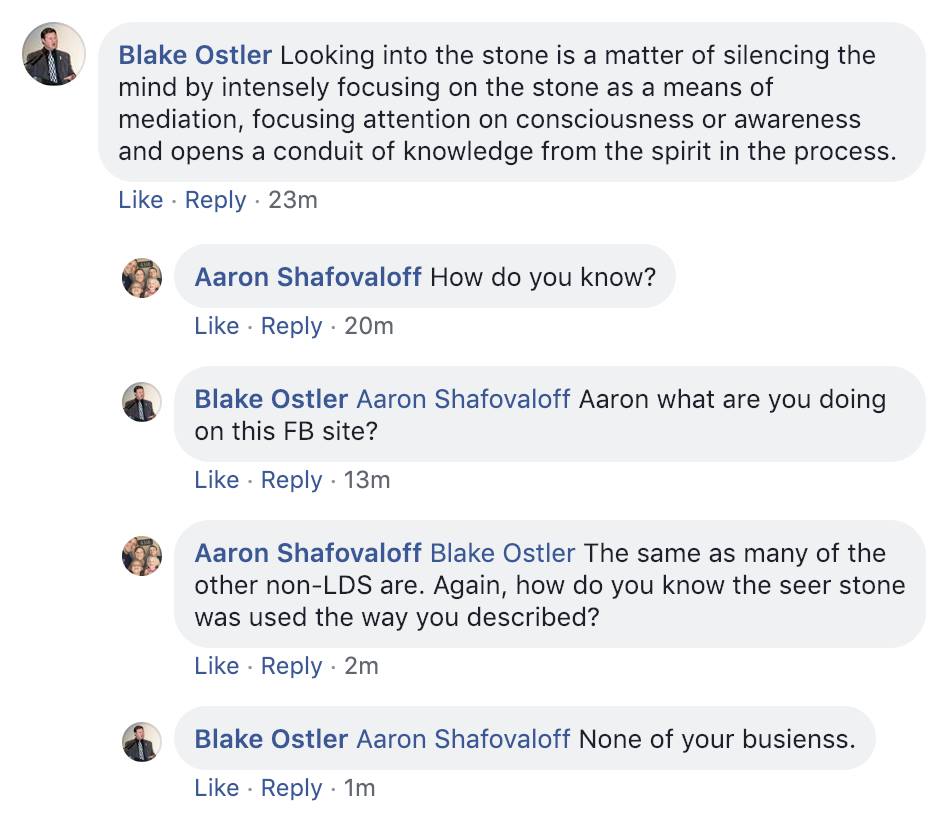


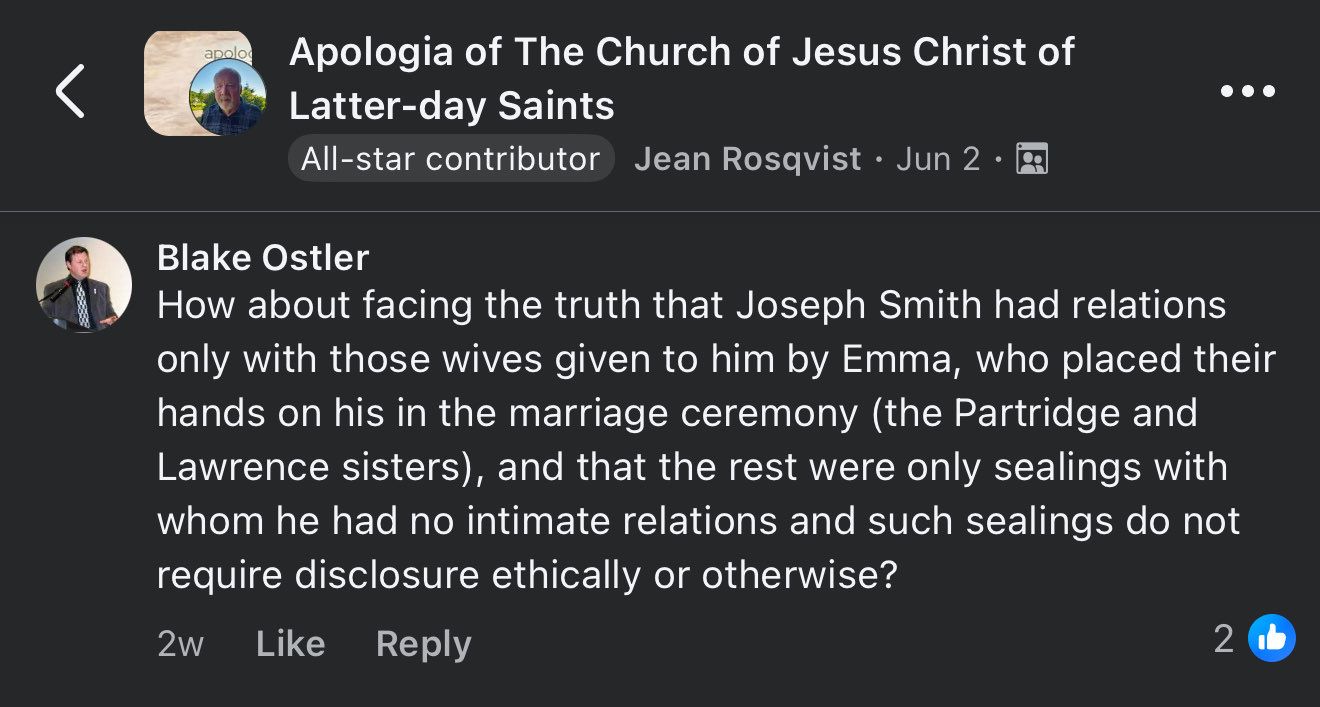


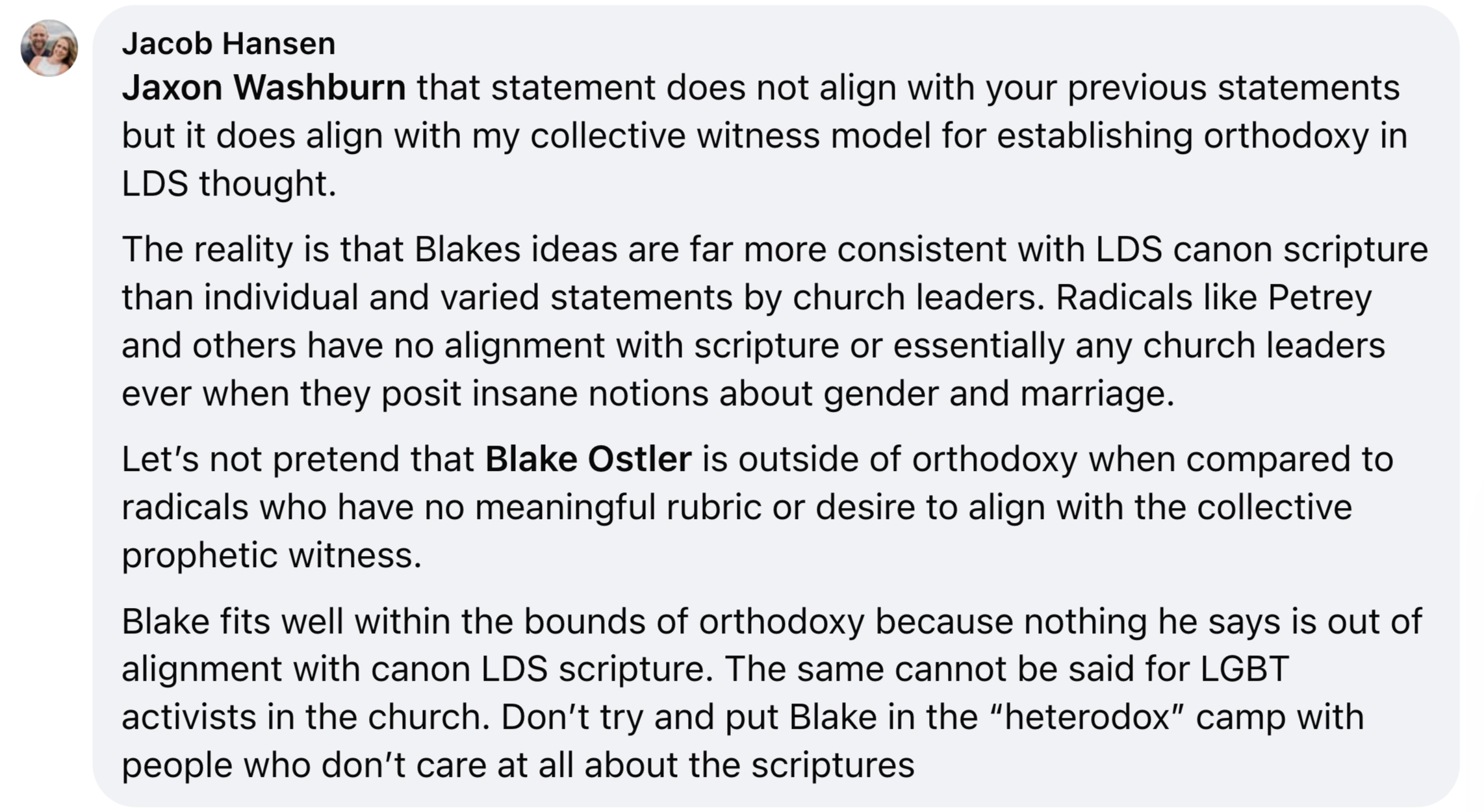


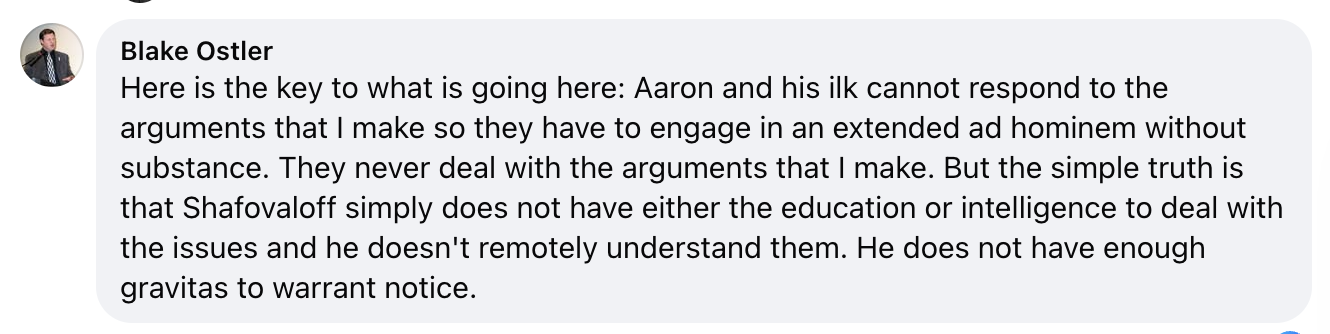


See also
- Dr. Loren Pankratz’s Critique of LDS Blake Ostler’s Theology (YouTube)
- Was Joseph Smith a Monarchotheist? An Engagement with Blake Ostler’s Theological Position on the Nature of God, by Loren Pankratz (Dialogue: A Journal of Mormon Thought, volume 55, no. 2, Summer 2022)
- Russell Ballard, “Beware of False Prophets and False Teachers,” Liahona, January 2000. Link.
- Ballard warns against those who “redefine the nature of the Godhead”, of “false teachers even attack the inspired proclamation on the family issued to the world in 1995 by the First Presidency and the Twelve Apostles”, and of false teachers who “arrogantly attempt to fashion new interpretations of the scriptures… They argue, therefore, that the scriptures require new interpretation and that they are uniquely qualified to offer that interpretation.” Ballard evidently has in mind LGBTQ-affirming false teachers, but the points of similarity are still notable.
You must be logged in to post a comment.