As of today there are at least five different positions in the Latter-day Saint tradition on divine ancestry and the regress of gods.
Infinite regress: Every divine son has a divine father, and every divine father is also a divine son.
Indefinite regress (or of unspecified extent): Our divine father is a divine son to another divine father, but we do not know whether that ancestry is infinite.
Finite regress: Our divine father is a divine son to another divine father, but this regress terminates on the first of all divine fathers, who emerged as the first god.
Agnosticism over regress: We do not know if our divine father is a divine son to another divine father.
Denial of regress: Our divine father is not himself a divine son to another divine father.
Dominant view and modern dissonance
“The notion maintained by many early Mormon leaders”
Blake Ostler (2001):
“The Lectures on Faith are inconsistent with the notion maintained by many early Mormon leaders that the God whom we worship has a Father, and this Father of God also has a Father and so on ad infinitum.”1
What “almost all Mormons believed”
Blake Ostler (2008):
“I believe that until recently almost all Mormons believed that Joseph Smith taught that God progressed to become fully divine from a lower state of non-divinity. Thus, it was believed that God the Father became God; before that, he was something less than God. During the eternal time period before which he was ‘God,’ or fully divine, he worshipped and was subject to another God, who was more ultimate than he was.”2
What “Mormons commonly believe”
Blake Ostler (2005):
“I believe that Mormons commonly believe that God the Father became God through a process of moral development and eternal progression to Godhood. The corollary of this view is that there was a time before which God the Father was a god or divine.”3
“The common held position amongst the majority”
Jacob Hansen (2025):
“I will concede that that has been probably the common held position amongst the majority of Latter-day Saints.”4
Present-day dissonance
Blake Ostler (2008):
“There still remains some dissonance regarding several issues related to the status of the head God. These issues include: (1) whether the God and Father of Jesus Christ is a supreme God in some sense—a Most High God who is the God of all other gods; (2) whether the Father is just one in an infinite hierarchy of gods and thus not a head God or God of gods; and (3) whether this head God is in fact the God and Father of Jesus Christ or some other divine figure altogether. The alternative to the view that the Father is the head God, who is the supreme God of all other Gods, is the view that the Father was merely appointed to become one of the head gods and that there are, logically, Gods more supreme and ultimate than the Father.”5
Infinite regress
Orson Pratt (1853):
“We were begotten by our Father in Heaven; the person of our Father in Heaven was begotten on a previous heavenly world by His Father; and again, He was begotten by a still more ancient Father; and so on, from generation to generation, from one heavenly world to another still more ancient, until our minds are wearied and lost in the multiplicity of generations and successive worlds, and as a last resort, we wonder, in our minds, how far back the genealogy extends, and how the first world was formed, and the first father was begotten. But why does man seek for a first, when revelation informs him that God’s works are without beginning? Do you still seek for a first link where the chain is endless? Can you conceive of a first year in endless duration? Can you grasp within your comprehension the first mile in an endless right line? All these things you will readily acknowledge have no first: why, then, do you seek for a first personal Father in an endless genealogy? or for a first effect in an endless succession of effects?”6
Though this quote by Pratt promotes an infinite regress, elsewhere Pratt surmised a first deity (see below).
Brigham Young (1854):
“I believe the gods never had a beginning, neither the formation of matter, and it is without end; it will endure in one eternal round… Consequently, when you hear philosophers argue the point how the first god came, how intelligence came, how worlds came, and how angels came, they are talking about that which is beyond their conception; about that which never was, and never will be[,] worlds without end. It manifests their folly. It shows they know nothing of such matters; and if they do know some things they have a right to know, there are things they have no right to know; this applies to all classes of mankind.”7
Heber C. Kimball (1857):
“We must be grafted into the true vine, and continue to partake of its fatness, and then we shall go back to our Father and God, who is connected with one who is still farther back; and this Father is connected with one still further back, and so on…”8
Brigham Young (1859):
“He is our Father—the Father of our spirits, and was once a man in mortal flesh as we are, and is now an exalted Being. How many Gods there are, I do not know. But there never was a time when there were not Gods and worlds, and when men were not passing through the same ordeals that we are now passing through. That course has been from all eternity, and it is and will be to all eternity. You cannot comprehend this; but when you can, it will be to you a matter of great consolation.”9
B. H. Roberts (1895):
“The Prophet Joseph Smith corrected the idea that God that now is was always God… But if God the Father was not always God, but came to his present exalted position by degrees of progress as indicated in the teachings of the prophet, how has there been a God from all eternity? The answer is that there has been and there now exists an endless line of Gods, stretching back into the eternities, that had no beginning and will have no end. Their existence runs parallel with endless duration, and their dominions are as limitless as boundless space.”10
B. H. Roberts (1933):
“Of course, such views as those expressed above involve us in the reality of a pluralistic universe, and a plurality of Gods; but the once terrifying horror of being open to such a charge as this has passed away now, in the new knowledge we have of the immensity of the universe and the localization of the revelations to man and his world. Indeed, it is held by some philosophical writers that the universe has outgrown God, at least as conceived in orthodox Christianity…
“All this, however—this extent and splendor of the universe—does not hinder the consistent conception that there have been appointed certain exalted, glorified and perfected intelligences, who have attained unto a participation in, and become partakers of “the Divine Nature” (II Peter i:4), who have been appointed as Presidencies over worlds and world systems who function in the dignity of Divine Intelligences, or Deities. Even as to our world and its heavens there has been appointed a Godhead, as taught by St. Paul…
“As in our earth and its heaven so in other worlds and world systems, there are doubtless appointed other Divine Councils that function in like capacity, or Godheads or Holy Trinities. Moreover, it is not inconsistent with Divine procedure to appoint intelligences to be Gods even on this world, and in this our mortal life…
“Thus exalted intelligences who have become “partakers in the one Divine Nature,” being united in brotherhood with others of like nature may be regarded as available for assignments to presiding stations among the Presiding Intelligences of the universes of the Gods—the sons of Gods, to preside in worlds or systems of worlds as may be required. This by the process marked off by our scripture lesson of this discourse in which we witness the Christ praying, namely, that he might be made One with God, the Father; that His Apostles might be made one with Him, as he and the Father were ONE. Neither did His prayer end there; but He prayed that those who became disciples of the Apostles—believers—might become one with them as they were with the Christ and Christ with God, the Father. “That they all might be one as Thou Father art in Me, and I in Thee, that they may be one in US. . . . I in them, Thou in Me, that they may be made perfect in One, that the world may know that Thou hast sent Me, and hast loved them as Thou hast loved Me.” All these that are thus united in one will have become partakers of the One Divine Nature—the God Nature. Of such are the Brotherhood of Intelligences of the Universe, the redeemed of celestial worlds. Of such may be chosen sons to preside as Deities over worlds and world systems as the Gods of eternity may determine or appoint. Therefore, let the universe be as extended and splendid as scientists or prophets conceive it to be, yet its extent and grandeur is paralleled by the glory of the Brotherhood of Exalted Intelligences everywhere governing within it, either in separate worlds or world groups, as a reign of law may determine. Splendid, I say, as the material universe may be, it has not outgrown the universe of “Mind” incarnated in the Personal Intelligences that hold all this manifest glory and awe-inspiring power in balance, giving direction and purpose to the whole. That the Church of the New Dispensation is officially committed to such a conception of the Gods of eternity as this, is evident from an official action in a signed document by the First Presidency of the Church and of the Apostles of the year 1865.” (emphasis in the original)11
LDS scholar Matthew Bowman on the teaching of Joseph Smith and many subsequent LDS leaders (2021):
“In a funeral sermon popularly known as the ‘King Follett Discourse,’ Smith offered a series of statements that seemed to indicate that God had once been a man like human men and had progressed to achieve Godhood and that this was to be also the fate of his listeners… In both this sermon and the so-called ‘Sermon in the Grove,’ preached two months later, Smith extended these ideas, teaching that there were generations of gods extending backward into eternity…
“Throughout the nineteenth century, many Church leaders embraced the notion that God had achieved godhood through a process of maturation, learning, and growth… Young took Smith’s meaning at its most frank, imagining a long chain of divine parents…
“For the Apostles James E. Talmage and John A. Widtsoe and the Seventy B. H. Roberts… it made much sense that God became God the same way that species evolved, through effort and education, and for thinkers influenced by Spencerian-modified Darwinism, Young’s emphasis on inheritance and lineage seemed appropriate.”12
LDS philosopher Joseph Lawal on a common LDS belief (2021):
“I think most people who think God is an exalted man actually think there is an infinite regress of Gods, so there was no first.”13
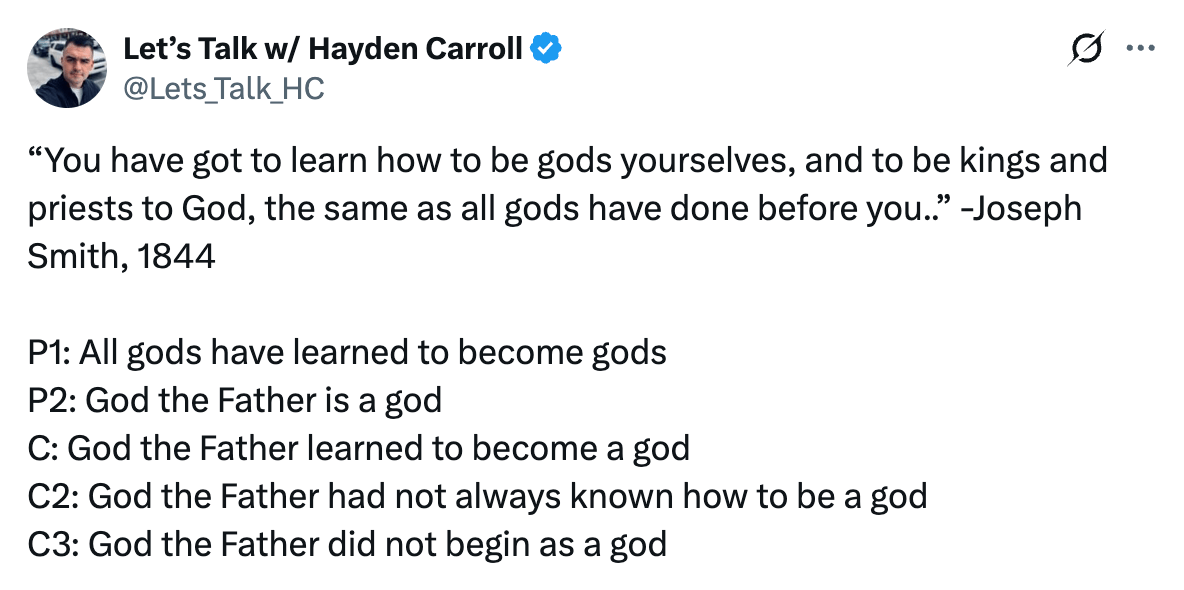
LDS apologist Hayden Carroll (2022):
“I take the more… traditional LDS view of: God was once a man, and that there is a never-ending line of deities who have become what they are today.”14
LDS scholar Stephen O. Smoot (2025):
“Infinite regress… has been the dominate [sic] reading of the sermon since Brigham Young. Both of these are theological inferences based on teachings in the KFD. I happen to think the infinite regress reading is probably the most logical reading of the sermon…”15
Stick of Joseph Discussion (April 7, 2026):
Hayden Paul: Essentially James White starts pressing Jacob: Your God is an exalted man. And Jacob keeps kind of punting and instead of answering it directly… “Does your church teach that God is an exalted man?” And that’s how James White references it. And Jacob just keeps going to the scriptures and reading verses that, “No, we believe that God is eternal. Eternal from beginning to the end, right?” And instead of just saying “yes” or “no,” “our Church teaches that,” — because the answer is historically our church has taught that God is some sort of an exalted man. Exactly what the details are of that can has been theorized.
Christopher Blythe: Universally taught this.
Hayden Paul: But it’s been universally taught that, right? Now Jacob has a problem. We’ve texted about it. We’ve talked about it in person a lot about the idea of infinite regression…
So Jacob does this. And in some ways I think it weakens his case. Even though I think Jacob absolutely won the debate, because James White was helping him. But it kind of seems a little bit weasily, like you’re not answering the direct question.
Austin Falter: Can I share with you the room? The room read? Because right after every time I go to one of these, I just want to talk to as many people as I can while they’re in the room. What’s your sense? Where did he struggle?
And so I was asking all of them, what was Jacob’s weakest point? Only a couple of people in the room were like, “I wish he would have just answered the question he asked instead of dodging it.” So I think online you might get people complain about it for sure. I think reading the room, people weren’t too mad.
Here’s the thing. I get why Jacob answered it that way because he was trying to go from the perspective of just Christians in general. Because that’s kind of a slam dunk. Like I don’t even have to pick up Mormonism. “We all agree that you’re crazy.” That that’s fine. But also I get it because Jacob legitimately doesn’t believe in infinite regress. And so he was answering honestly from his perspective. And it might look like he’s being weasily, but it’s also like, no, he’s just being difficult. Because he actually does believe that. He’s not being weasily.
Jonah Barnes: And he knew where this was leading. He knew where it was leading. And that’s why, “Is your God a an exalted man on another planet?” Jacob says, “My God’s eternal.” And to somebody who doesn’t know, that might seem like a weird answer. “Wait, why are you saying your God’s eternal?” Because Jacob knows where this is going. And where it’s going is, “If your God,” and Dr. White says this several times, “If your God is merely an exalted man on another planet, and he isn’t existence itself.” You know, if he isn’t that, if he isn’t the Squid Game tyrannical god of wrath, then you have no basis for morality. That’s Dr. James’ argument. So, and one thing they say, “You believe God was created, so he’s not eternal.” And Jacob, rightfully so, quotes many scriptures we have that say he is eternal. And we have that in here. And so Dr. White was trying to press him and say, but your God isn’t as big as my God. Right? Right? Right? You’ve taught this thing that shows your God can’t be the basis of morality. And Jacob was trying to say, I know where you’re going with this, and it’s not gonna work because our God is eternal. And that’s what they played out.
Hayden Paul: And so the two camps, real quick, I want to represent and get your thoughts on it…
Christopher Blythe: There’s three camps…
Hayden Paul: One camp is—and I think I’m trying to steelman Jacob’s position, we’ve had a lot of conversations about it. But correct me if I’m wrong.
Jacob believes that there is one eternal God, and that is the God that we’re talking about: God the Father. And that there are other gods that maybe have been exalted throughout time or whatever. But there is one that has been God from everlasting to everlasting in the sense of: he has been God forever. There’s no time period… where he hasn’t been an exalted God the Father.”
Christopher Blythe: The most exalted.
Hayden Paul: The most exalted, right? And so that’s one perspective. But that we can exalt and become like God and participate in creation. But there still will always be that Father God, right? So that’s that’s one perspective.
The other perspective is that eternally there have been people that have been—there have been beings that been on this road of progress and creating and progressing like this. And there isn’t necessarily a God that was a God from beginning. But there is no beginning, right? And that’s one way of looking at it. There is no beginning, so there can’t be a God from beginning, because there is no beginning to begin with. So that that’s kind of the ultimate regression.
Austin Falter: To represent this view, if we are going to be exalted—joint-heirs with God. And it takes this life and progress and the the atonement of Christ to help us get kind of get there: How did God get there?—is how people will I guess—”speculate” is the wrong word—because this has been doctrine. But that’s how they’ll explain that.
Hayden Paul: And what’s a third?
Christopher Blythe: Joseph taught this thing, right? King Follett Discourse. It’s really pretty clear.
Jonah Barnes: It’s not ambiguous.
Christopher Blythe: If you’re gonna sit down and try to fit it to a bunch of Protestants—the apostates—you’re gonna run into problems. If you sit down and try to have the conversation on their terms? Yeah, then you gotta hedge, you gotta change doctrines, you gotta do all this stuff. Dismiss them without further argument. You don’t need to do that, right?
And so Joseph says, we’re all eternal. God is eternal. You’re eternal too. And that he was once a man, and that he has a Father. This is infinite regress. He says it very clearly, and he already makes the case of the two points here.
Blake Ostler shows up and he says: Hold on. What if we just look at the King Follett Discourse and not all the others? Isn’t it possible that what it’s saying is there’s one head God? Now I’m gonna go back to Ostler’s point. Now Jacob’s saying something similar in other materials and Cardon [Ellis] and so on are saying something similar.
But they’re a third school because Blake Osler doesn’t like that these people—YouTube Mormons—I’m just playing, you guys. But, these guys are forgetting Lorenzo Snow’s couplet. Like he believes, yeah, there’s a head God, but he actually was once a man. And he says that process just began at a certain point with this head God, the Father of Jesus. And that starts the cycle. Jacob, I believe, and others are getting rid of that—that he was once man. And Jacob, you can correct me if I’m misrepresenting you…
Austin Falter: I’ve heard people talk about that—and you can look up quotes from church fathers—that sound very similar to that couplet, where it’s: Christ did become a man.
Christopher Blythe: And so what we’re doing is conflating—we’re conflating. Look, we’re wanting—because it’s so much better—we’re saying, yeah, let’s be—is it Origen? Who’s the one who gives the one? “He became man so we could become God.” Beautiful quote. And that’s a great quote, but it’s not what Lorenzo Snow was talking about. We know what Lorenzo Snow is talking about. He explained it to us.
He’s saying that God was once a man and we can become like God. And we can become gods. It’s a bold claim. It’s not, I mean—the founders of our church weren’t idiots. They knew that people already thought that about Jesus. They’re saying something radical. We’re saying he was once a man. And yeah, men are created in the image of God. You were never really just once a man. But that he went through the same process.
Jonah Barnes: And we’re not the only ones who believe this actually. Because if anybody here has been reading their Armenian Apocrypha… This is a wonderful dissertation by W. L. Lipscomb who talks about this in the Armenian tradition.
This is not just us. This is not just us. There were faithful Christians centuries and centuries ago in Armenia who believed this. That the serpent says to Eve in the garden, says, “God wants to deceive you. For God was like you, because he had not eaten the fruit. When he ate it, he achieved the glory of divinity. For this reason he said to you not to eat of that fruit, so that you should not become equal shares both of God’s glory and his throne.”
“Not so,” the serpent says, “because God himself was a man like you when he ate it, and he became God of all. Because of that he said not to eat of it, because he knew that when you eat of it, you will become a God—his equal. Because of that he said for you not to eat.”
Now, that’s the serpent saying it, you know. But this idea, I guess, I’m not sure why it’s so heretical. I guess I’m not sure why it’s so awful.
When Joseph Smith says something, or when God reveals this wonderful truth, I don’t like the reflex of, well, “We better wrap this in bubble wrap.” I don’t like that. I don’t like that reaction. I like to say, all right, I’ll deal with it how I can. But I tend to defer to to Joseph.
I don’t understand why it’s such a problem to have an [sic] infinite cycles. I don’t know why that’s an issue. Now, that might be an issue in the Grecian philosophical Platonic framework of, “Well then, well then, the other, and you follow the lawyer down the rabbit hole.” Fine, whatever.
I’m okay with with apparent contradictions. I’m okay with mysticism and with things I don’t understand. I’m okay with unanswered questions. Seems like Joseph was being pretty clear when he said what he said. And I don’t understand why that is such a big problem.
Christopher Blythe: He even says the line, “I refuse to be afraid to death of the question.” Right?
Jonah Barnes: He knows perfectly well that this is blasphemy.
Christopher Blythe: Absolutely.
Hayden Paul: And one of one of the reasons why—and the main reason, as I’ve gone back and forth with Jacob [Hansen] on this—and I’d love to have a conversation about this. It’d be fun to have a conversation with—because I know, like, Cade Alvey, for example, is not an infinite regress guy. So it’d be good to have like Cade and Jacob on one side…
Jonah Barnes: When Joseph said in the King Follett Discourse: this ring I have on? If you cut this ring, you give it a beginning, and you also give it an end. If something’s eternal, it’s eternal. It never ends and it never started. Eternity doesn’t start. It just is. Okay. I believe that to be a very deep truth. I think that is very true. And the Spirit testifies to me that that’s true.
So when I think, okay, if there’s a head God, you know, who was the first and all these things, I’m thinking, I don’t like first. I don’t like beginning, because you’ve cut the ring. If there’s a beginning, there’s an end. If there’s a first, there’s a last. I don’t like that. I don’t like that.
Now the the argument that I’ve heard against infinite regression, which I think is the best argument, is… that, well then Christ’s atonement is not truly infinite in the way I define infinite. And if it isn’t truly infinite, well then that lessens Christ. It lessens Jesus in my eyes or whatever. And that’s the best argument that I’ve heard against that.
And so you think, oh so are there infinite Jesuses too? Gets a little weird. It’s a little weird.
Christopher Blythe: I do believe Christ is the savior of multiple worlds, right? I think this is a key doctrine that the early saints believed. Brigham Young does say: one savior and one tempter per each world. I I think he’s wrong. I think Joseph really did say Jesus was… There is an idea in Moses that for me says, look, he’s—there’s multiple worlds that Christ is the savior from. And just like the Nephites learn about Jesus, even though he’s not there, I believe there are worlds that learn about the Savior even though he wasn’t on their planet…
But I do also believe that there are other gods. And when a Protestant asks me questions like this? I would never participate in a debate with a Protestant like this. And I have complete adoration for Jacob [Hansen] doing so. But I would I would never do that, because I think some of the stuff is just none of their business. I think the Spirit isn’t teaching them this stuff for a reason… But I don’t think they’re ready for it.16
Jonah Barnes (April 11, 2026):
“I think their concern [that of ‘anti-Mormons’] is legitimate, because the majority members of the Church and all the apostles and all the prophets since the beginning of the Restoration, I believe, have manifestly, overtly, publicly taught the infinite regress of gods… Like, I didn’t even realize there was another option. I mean, I grew in the Church—I didn’t realize that you could…
“If you tell our critics or historians and say, ‘Oh, no, no, no. Infinite regress is some fringe thing that has never been official doctrine.’ They’re going to they’re going to rightfully say, ‘You’re wrong.’ This is all over…
“I’m not saying it’s official doctrine, but it really sounds like trying to distance oneself from the teachings of our historical leaders…
“It’s totally fair to say I interpret these things differently. But you got to be able to understand, when the antis say, ‘Hold on a minute. All these statements, all these pages, and all these sermons from all these leaders all the way up into the 1970s all sound like they’re teaching this doctrine.’ You can’t just ignore that, right? That’s what they’re going to say… If you’re going to pretend like the anti are going to let you off the hook for this, you’re delusional…
“It doesn’t matter if the antis say this, but your youth and my youth are going to Google this and they’re going to say, ‘this has been taught for decades.’ And I can’t just ignore it and pretend like it didn’t exist.
“You’re going to have a teenager who is going to Google these things, and you’re teenager is going to say, ‘Why are you running away from these teachings. And you can’t just shrug…”17
“I had no idea that non-infinite regress was even an option. And I’m not being funny. Like, I literally did not until like a year ago. Like a year ago and somebody was like, ‘Oh, infinite regress.’ And I was like, ‘What?’”18
Jonah attributes opposition to infinite regress to the “philosophies of men”:19
In these quotes some regress is indicated, but the extent of regress is not specified.
Orson Hyde (1853):
“God, our heavenly Father, was perhaps once a child, and mortal like we ourselves, and rose step by step in the scale of progress, in the school of advancement.”21
John Taylor (1874):
“The principles that we believe in reach back into eternity. They originated with the Gods in the eternal worlds, and they reach forward to the eternities that are to come. We feel that we are operating with God in connection with those who were, with those who are, and with those who are to come.”22
Charles Penrose (1884):
“But, if God is an individual spirit and dwells in a body, the question will arise, ‘Is He the Eternal Father?’ Yes, He is the Eternal Father. ‘Is it a fact that He never had a beginning?’ In the elementary particles of His organism, He did not. But if He is an organized Being, there must have been a time when that being was organized. This, some one will say, would infer that God had a beginning. This spirit which pervades all things, which is the light and life of all things, by which our heavenly Father operates, by which He is omnipotent, never had a beginning and never will have an end. It is the light of truth; it is the spirit of intelligence…”
“He is the perfect embodiment and expression of the eternal principles of right. He has won that position by His own exertions, by His own faithfulness, by His own righteousness. Jesus Christ, the only begotten son of God in the flesh, but His firstborn in the spirit, has climbed His way up in a similar manner.”16
Joseph F. Smith (1884):
“God has a tabernacle of flesh and bone. He is an organized being just as we are, who are now in the flesh…
“We must go through the same ordeal in order to attain to the glory and exaltation which God designed we should enjoy with him in the eternal worlds. In other words, we must become like Him; peradventure to sit upon thrones, to have dominion, power, and eternal increase…
“We are precisely in the same condition and under the same circumstances that God our Heavenly Father was when He was passing through this or a similar ordeal.”23
James E. Talmage (1899):
“We believe in a God who is Himself progressive, whose majesty is intelligence; whose perfection consists in eternal advancement; the perpetual work of whose creation stands ‘finished, yet renewed forever;’—a Being who has attained His exalted state by a path which now His children are permitted to follow; whose glory it is their heritage to share. In spite of the opposition of all other sects, in the face of direct charges of blasphemy, the Church proclaims the eternal truth, ‘As man is, God once was; as God is, man may become.’”24
Nels L. Nelson (1904):
“Since by this conception He is made to be- long to the same order of beings as Christ, His Son, — the same order, indeed, as man himself, — and must consequently have attained to Godhood or creative power, it becomes a pertinent question to consider how He reached such divine sovereignty, (i ) Was He elected to the supreme place ? Election may confer dominion, — it cannot add an iota to native ability ; but is not dominion part of divine supremacy? (2) Was Godhood conferred upon Him? Ordination may give place and opportunity, — it cannot give creative power. But are not place and opportunity vital relations in creative power? (3) Did He attain to Godhood by the gradual development of powers inherent in His very being?”
“Whatever the answer shall be to these questions, one thing may be absolutely predicated on the start: He is God primarily by reason of supreme fitness; for Godhood, being omnipotence or the power to create in harmony with the infinite unity of the universe, is a thing, like brains, not conferrable by authority nor purchasable by money or influence. A being has either attained to this power, or he has not attained to it, by native self-effort. The universe itself could not give it to any man. A sufficient general answer, therefore, would be that God became God because He fulfilled the law of becoming perfect as His Father in heaven was perfect; or, in the terms of science, because He fulfilled the supreme requirements of psychic evolution.”25
Lycurgus A. Wilson (1905):
“As to the personage meant, one may say, There are many Gods, an almost endless chain of creators; to which one does the Prophet refer? We are not left in doubt, for he explains: “If the vail were rent today, and the great God, who holds this world in its orbit, and who upholds all worlds and all things by His power, were to make Himself visible,—I say, if you were to see Him today, you would see Him like a man in form.” And further: “My object is to find out the character of the only wise and true God, and what kind of a being He is.” With these prefatory remarks, the Prophet Joseph proceeds to tell how God came to be God, in what must appeal to one as among the divinest words ever uttered…
“Whether or not, in the vast eternities preceding the creation of Kolob, other plans had been tried and found wanting, we are not told; but the fact that, as the Prophet Joseph tells us, God “worked out His Kingdom with fear and trembling,” would indicate that He had seen many failures.”26
John A. Widtsoe (1915):
“We may be certain that, through self-effort, the inherent and innate powers of God have been developed to a God-like degree. Thus, he became God . . . attained by the use of his power in simple obedience to the laws he discovered as he grew in experience.”27
James E. Talmage (1915):
The Father… “was once a Man, and has progressed, not by any favor but by the right of conquest over sin, and over death, to His present position of priesthood and power, of Godship and Godliness, as the Supreme Being whom we all profess to worship.”28
Joseph F. Smith (1919):
“The man who passes through this probation, and is faithful, being redeemed from sin by the blood of Christ, through the ordinances of the gospel, and attains to exaltation…
“The resurrected, righteous man has progressed beyond the pre-existent or disembodied spirits, and has risen above them, having both spirit and body as Christ has, having gained the victory over death and the grave, and having power over sin and Satan; in fact, having passed from the condition of the angels to that of a God. He possesses keys of power, dominion and glory that the angel does not possess—and cannot possess without gaining them in the same way that he gained them, which will be by passing through the same ordeals and proving equally faithful.”29
Milton R. Hunter (1945):
“How did the Eternal Father become God? . . . He became God by absolute obedience to all the eternal laws of the Gospel – by conforming His actions to all truth, and thereby became the author of eternal truth. Therefore, the road that the Eternal father followed to Godhood was one of living at all times a dynamic, industrious, and completely righteous life. There is no other way to exaltation.”30
Heber Snell’s conversation (~1951-52) with Joseph Fielding Smith as recounted (1986) by Sterling McMurrin:
“He raised a question with Joseph Fielding as to how he, Apostle Smith, could regard God as an absolute being in every sense of the word. (He used the word “absolute,” and Joseph Fielding [k]new what he meant. I could tell in his reply he knew roughly at least what Snell meant by “absolute.”) and still hold as he did that God used to be like we are now, and that he had to go through a process of schooling and progress up to the point of becoming a God. Snell said, “How can you reconcile these two things?” Joseph Fielding’s answer, I thought, was marvelous. He said, “God was,”–and he used the word “relative.” “God was a relative being just like we are now up until the moment that he became God, and then he became an absolute being.”31
Joseph Fielding Smith (1954):
“God is an exalted Man… The Prophet taught that our Father had a Father and so on.”32
Bruce McConkie (1958):
“Further, as the Prophet also taught, there is ‘a God above the Father of our Lord Jesus Christ.”33
Truman G. Madsen (1966)
“Now the Creeds say that God has always been God. But this well-motivated expression of reverence is a solemn travesty. The truth is infinitely more inspiring: that God Himself became God (whose power now extends in and through all things) by the mastery of the same ultimate and unchanging conditions to which you and I are subject. So, likewise, did His Firstborn Son, Jesus the Christ.”34
David L. Paulsen (1975):
“The being who is God has not always been God—i.e., he has not always qualified for the honorific title ‘God’—a distinction earned through a process of growth and development toward Godliness.”
“In accord with classical theism, Mormon theism affirms that God perfectly exemplifies every moral value. That is, He is perfectly just, loving, kind, compassionate, veracious, no respecter of persons, etc. But His perfections are not eternal, but were acquired by means of developmental process.”
“God, then, according to Mormon theology is not unconditioned or unlimited. He is limited at least by other co-eternal existences: primal elements (mass-energy), space, time, primal intelligences (selves) and primal laws and principles. Nor has he always been ‘God.’ At some distant point in an infinite past, He earned the right to be ‘God’ through a process which men, as his children, are now repeating.”35
Achieving a Celestial Marriage (LDS manual published in 1976 and 1992):
“Our Father in heaven was once a man as we are now, capable of physical death. By obedience to eternal gospel principles, he progressed from one stage of life to another until he attained the state we call exaltation or godhood. In such a condition, he and our mother in heaven were empowered to give birth to spirit children whose potential was equal to that of their heavenly parents…”
Robert L. Millet and Joseph Fielding McConkie (1986):
“Our Father’s development and progression over an infinitely long period of time has brought him to a point at which he now presides as God Almighty, He who is omnipotent, omniscient, and, by means of his Holy Spirit, omnipresent: he has all power, all knowledge, and is, through the light of Christ, in and through all things.”36
Joseph Fielding McConkie (1998):
“God was once a man obtaining his exalted status by obedience to the laws of his own eternal Father.”37
LDS apologist Devin Barnes (2025):
“I just became a father. And even though I’m a father, my father and I are not equals. My father has become a grandfather, and my son has potential to become a father like me. Fatherhood is passed down.
“If this seems common sense to you, then you would love Mormonism. We believe God is our Father. We believe that, as the Bible teaches, we have the potential to become like our Father.
“Jesus Christ inherited all that the Father has. So even though a Jesus is the Son of the Godhead or Trinity for us, He has become the Father in a new Godhead. If you don’t believe Jesus has become the Father of his own Godhead, then you don’t believe that Jesus received all that the Father has.
“Just as I have a Father, even though I am a father. God has a God, even though He is a God. We see that pattern take place with Jesus, because we know that Jesus is God. Yet Jesus refers to his own God. Therefore, God can have a God.
“So it makes the most logical sense to me that Heavenly Father, God, has a God of his own, and his God has a God. Just like my father has a father and his father has a father. That’s all that godhood is, really, is fatherhood.
“So you might ask, okay, then who is the first God? I don’t know if there was a first God. What if that it was an infinite regression of gods? Because if you can believe that God was God forever, and he goes back forever, is it that much of a stretch to believe that there have been gods forever?”38
Finite regress
Wilford Woodruff records on June 26, 1847 a conversation with Orson Pratt:
“Then the question arose how did God receive his present formation? The Answer given by Professor Pratt was sumthing in the following language:
“He sayes I throw out my Ideas not as doctrin but for you to look at. You know when A Chemist goes to work to Analize or try new experiments they often have to try many times before they put a thing perfect & take certain processes which are unnecessary an are afterward laid aside And pursue the most perfect Course that can be [pursu]ed. It may reasonably have been the case with the first being [form]ed which may be Called God. As eternity was filled as it were with particles of intelligence who had there Agency, two of these particles in process of time might have joined their interest together exchanged ideas found by persueing this course that they gained [double?] strength to what one particle or intelligence would have & afterwards were joined by other particles & continued untill they formed A combination or body though through a long process.
“Yet they had power over other intelligences in consequence of their combination, organization & strength And in the process of time this being body or God seeing the Advantage of such an organization desires company or A companion and Having some experience goes to work & organizes other beings by prevailing intelligences to come to getehr & may form sumthing better than at first. And After trials of this kind & the most perfect way sought ought it was found to be the most expeditious & best way to receive there formations or bodies either spiritual or temporal through a womb.”39
Though uncommon, the finite regress view (with a first God who exalted himself from a prior state of non-exaltation) finds occasional representation among LDS members. Among those who hold to it, some are agnostic over whether our particular God is the absolute first, while others are confident that ours is the first (compare: denial of regress). One Mormon writes,
“He was the first to find exaltation, and found a way to exalt himself without needing another god to help him. He then organized/created the cosmos and devised a plan whereby lesser intelligences, prone to sin, could still attain the same exaltation he had discovered. Because God is love and does not covet his own happiness. Thus, we can become gods, and yet God always remains our God and there is no one above him.”40
Agnosticism over regress
Casey Paul Griffiths (2024):
“If God was once a man, do we know the planet that God lived on? No. Do we know if he was a good kid in high school or a bad kid in high school? Do we know if he had a mother or father — is there a Heavenly Grandpa? Which would be awesome. If there’s a Heavenly Grandpa I’m first in line to give Heavenly Grandpa a hug.”41
In 2026, popular LDS fiction author Shad Brooks stated that he “personally … [doesn’t] think God the Father has a Father,” but that Joseph Smith suggested it as a possibility and might have believed it:
“We don’t know if Joseph Smith supposed that God the Father might have had a Father. If he had a mortal experience, it’s logical to assume that he could have had a mortal father. But in terms of having a spiritual father, and God the Father starting out as a spiritual child like we have—we actually don’t know if Joseph Smith believed that. We don’t have 100% confirmation on it at all. We have him speculating that maybe that could be the case, and we don’t have to be afraid of it. But even in the Sermon in the Grove, that could be referring to his mortal father and the mortal experience he had, not that he was spiritually begotten of another god.
“And so to state that it is official Mormon doctrine, and that our scriptures state this—that we believe in an infinite regress of God—that is false. Many members believe it. They’re entitled to believe it. We shouldn’t be afraid of entertaining the idea. I personally don’t believe in the infinite regress of God. It doesn’t contradict scriptures. I’m not going to be excommunicated for it because it’s not official doctrine. Okay? And we don’t even know if Joseph Smith ultimately believed that. We know that he speculated on it, but we don’t know what he ultimately concluded on.”42
Christian Williams of Holy Rebellion (July 16, 2025):
“This comes from the King Follett Discourse, where Joseph Smith, prior to his martyrdom, talks about God the Father being once as we are now. And this is one of those speculative but not doctrinal things people love to run wild with.
“There are two main models here. One is that infinite regress model, where God the Father had a Father, and that God the Father had a Father. And so there’s this infinite regress of Gods And honestly, I wouldn’t mind having Heavenly Grandparents spoiling me for eternity.
“The second model here is the head god model put forth by Blake Ostler. God the Father is the head, the origin, the one who presides over all. In this view, the quote, “God once was as man is now,” could mean he descended from divinity to mortality voluntarily at some point—similar to Jesus.
“In the end, we don’t know. And it’s not a central teaching. We worship God the Father and His Son, not other gods.”43
Denial of regress
Though Parley P. Pratt writes of “our relationships and affinities with the past, present and future, with time and eternity, with Gods, angels, spirits and men, who have gone before us,” he does not seem to think this implies a regress prior to the “Father of all.” Parley affirms that “there is one Supreme Head, who is over all” and that the Gods and their kingdoms are “in subordination to the great Head and Father of all” in his Key to the Science of Theology:
“All these are kingdoms which, together with their Kings, are in subordination to the great Head and Father of all, and to Jesus Christ the first born, and first heir, among the sons of God. All these kingdoms, with all their intelligences, are so many acquisitions to His dominion who is Lord of lords, and King of kings, and of whom it is written, by the Prophet Isaiah, ‘Of the increase of his kingdom there shall be no end.’”44
Parley composed most of this work while away from Utah. He wrote in San Francisco, during his Chile mission (1851-1852), and during his return voyage. The book was published in March 1855. Parley was murdered in 1857 and didn’t have more time to articulate or further develop his pioneer LDS theology.
Blake Ostler (2006):
“While Joseph Smith did not have such a view of an eternal chain of gods, it appears to me that Brigham Young did. However, it seems to me that his view of the chain of gods is tied up in his Adam-God theology and ought to be rejected as unsound doctrine by Latter-day Saints.”45
Travis Anderson (2020):
“Aaron is often relying on the Doctrinal (sic) ignorance of those he interviews. He never presents King Follett in an accurate and complete context and draws conclusions our theology can’t support. For example, that God was not God at some point in the past. The reality as we see in the Hebrew texts and such texts as Ether, specifically Ch 3., is God’s (sic) have their Godhood bestowed before they become mortals… [The] regression of Gods idea is flawed for a number of reasons, among them being it is rejected by most scripture.”46
In 2026:
“Usually, when people are challenging the church using the King Follett sermon, they’re usually referring to specific language regarding a doctrine that’s called eternal regression—this idea that God was not always God; so God had a God, had a God, had a God. I don’t believe the sermon teaches that doctrine.”47
Jacob Hansen (2021):
“There’s an idea out there that’s very common based on the King Follett Discourse that… God had a father, and he had a father, and he had a father, he had a father, and all goes back, back, back, back, back… It’s just this infinite regress of God. And our God is just another God in the series. And we’ll be one of the next gods in the next series. And you kind of give a different take on that…
“[But] there is an eternal God the Father, in other words, rather than this idea of just an infinite regress of one God than another, then another, then another…
“You [Blake Ostler] actually were the one who, for me… You’ve been very influential, especially on that particular issue, because I’ve always had an issue with the infinite regress idea… Like you’re saying, I hear a lot about an ‘eternal God’ all the time—’Alpha and Omega’, ‘Beginning…’—it’s like this just seems like something’s missing here.”48
In 2025 Hansen makes a number of concessions:
“So it is not something that has been sort of defined by the Church as like absolutely one way or another. And so therefore it’s something that Latter-day Saints have different opinions on. And this is important because evangelicals and many other Christian groups will make the claim that that basically my view like isn’t a Latter-day Saint view at all. And so I think we could agree that at least what we can say to them is if they bring up, well, “You believe that God had a father had a father had a father,’ like that isn’t— that’s sort of an open question.”49
When asked, “Do you think Joseph Smith believed in an infinite regress?”, he answered,
“I’m agnostic on that.”
LDS Theologian Test (April 2026)
A survey designed by BYU students Noah Airmet and L.J. Saurman received 3,980 answers to a question about infinite regress. Noah reports:
There’s the three main options you can see here:
Yes, there’s an infinite chain.
Possibly, but it’s speculative.
Or no, but it’s agnostic.
Only about 25% of people firmly committed to infinite regress. We had yeah 1,100 respondents said [sic] yes, there is an infinite chain.
The vast majority, about 50% said “possibly,” but it’s speculative.
Then about 581 responded resoundingly “no,” or they were agnostic to it. That’s about 15%.
So that’s just a breakdown. [It’s] demographically potentially skewed more towards people who are philosophically-minded. So it doesn’t mean anything about general breakdown of the Church. I think if you were to do a global survey of the Church membership, especially in developing countries and worldwide, you would probably get a lot more people who would say, “they don’t know,” or have no stance.50
Disputed
This 1854 quote by Brigham Young may be about Adam-God, and not the regress of gods.
“You will not dispute the words of the Apostle, that he is actually the God and father of our Lord Jesus Christ, and the father of our spirits. You may add these words to it or let it alone, it is all the same to me: that he is not only the father of our spirits, but also of our flesh, he being the founder of that natural machinery trough which we have all obtained our bodies. Do you wish me to simplify it? Could you have a father without having a grandfather? or a grandfather without having a great-grandfather? … Does this unlock to your understandings how the Lord Almighty is our natural father? He set the great machine to working. If you cannot see this truth now, you will if you are faithful and patient.”51
Critics and outsiders
Nauvoo Expositor (1844):
“They have introduced false and damnable doctrines into the Church, such as a plurality of Gods above the God of this universe… We hereby notify all those holding licences to preach the gospel, who know they are guilty of teaching the doctrine of other Gods above the God of this creation.”52
Richard F. Burton (1860):
“From the Christian apostles and the Apocalypse, the Mormons deduce the dogma of gods in an ad infinitum ascending series: man, however, must limit his obedience to the last heavenly Father and Son revealed by the Holy Spirit. And as God is perfect man, so is perfect man God: any individual, by faith and obedience, can, as the Brahminical faith asserts, rise to the position of a deity, until, attaining the power of forming a planet, peopling, redeeming it, and sitting there enthroned in everlasting power.”53
References
Blake T. Ostler, Exploring Mormon Thought: Volume 1, The Attributes of God (Salt Lake City, UT: Greg Kofford Books, 2001), 15. ↩︎
Blake T. Ostler. Exploring Mormon Thought: Volume 3: Of God and Gods. Salt Lake City: Greg Kofford Books, 2008, 31-3. ↩︎
Blake Ostler, “Re-vision-ing the Mormon Concept of Deity”, Spring 2005 in Element: The Journal of the Society for Mormon Philosophy and Theology. Link. ↩︎
Blake T. Ostler. Exploring Mormon Thought: Volume 3: Of God and Gods. Salt Lake City: Greg Kofford Books, 2008, 24. ↩︎
The Seer, page 132. Link. Quoted by Matthew B. Brown in The Plan of Salvation, p. 9. Covenant Communications. January 2007. ↩︎
Brigham Young, “For This is Life Eternal” (October 8, 1854). Link. ↩︎
Heber C. Kimball, “Temple and Endowments, Etc.”, Journal of Discourses, vol. 5, p. 19, April 6, 1857. Link. ↩︎
Brigham Young, “Progress in Knowledge, Etc.”, Journal of Discourses, vol. 7, pp. 333, October 8, 1859. Link. Quoted by Turner, Rodney. “A Discussion of Lectures 3 and 4: The Imperative and Unchanging Nature of God.” In The Lectures on Faith in Historical Perspective, edited by Larry E. Dahl and Charles D. Tate Jr., 199–220. Provo, UT: Religious Studies Center, Brigham Young University, 1990. Link. ↩︎
Roberts, B. H. In A New Witness for God, chapter 30. Salt Lake City: George Q. Cannon & Sons Company, 1895. Google Books. Project Gutenberg. ↩︎
B. H. Roberts, Salt Lake City Tabernacle, Sunday, January 23, 1932. Published in Discourses of B.H. Roberts of the First Council of the Seventy (Salt Lake City: Deseret Press, 1948), 93–94. Link. ↩︎
Bowman, Matthew (2021) “What Is the Nature of God’s Progress?,” BYU Studies Quarterly: Vol. 60: Iss. 3, Article 6. Link. ↩︎
Mar 7, 2021 post on X. Accessed March 20, 2025. Link. ↩︎
Hayden Caroll. “Theology Talk Ep 1: Has God Always Been God? Blake Ostler Says Yes.” 5:26-5:41. Link. ↩︎
Comment in “The Calvary”, a Facebook group for LDS Missionaries. March 3, 2025. Accessed March 3, 2025. Link. Screenshot. ↩︎
1:33:01 in “Debate Breakdown: Jacob Hansen VS. James White of @ApologiaStudios”, Stick of Joseph and Eyes 2 See, YouTube video, April 7, 2026, https://youtu.be/ZDYw6d4PBcA?t=5581. ↩︎
Jonah Barnes in “Take the LDS Theologian Test LIVE! (Part 1)”, Ward Radio, YouTube video, 33:48, April 11, 2026. Accessed April 12, 2026. https://youtu.be/IZIk6ldzXt0?t=2028. ↩︎
Jonah Barnes in “Take the LDS Theologian Test LIVE! (Part 2)”, Ward Radio, YouTube video, 10:18, April 11, 2026. Accessed April 12, 2026. https://youtu.be/suABdSbA1I4?t=618. ↩︎
Orson Hyde, in Journal of Discourses, 26 vols. (Liverpool: F. D. Richards, 1855–86), 1:123 (October 1853). Link. ↩︎
John Taylor, “Destruction of the Wicked, Etc.”, Journal of Discourses, vol. 17, pp. 206, October 7, 1874. Link. ↩︎
February 17th, 1884, Journal of Discourses 25:58. ↩︎
James Talmage, Articles of Faith, p. 430. Link. James E. Faulconer and Susannah Morrison write, “God’s progress to godhood is taught without reservation in James Talmage’s Articles of Faith.” (“The King Follett Discourse: Pinnacle or Peripheral?”, link). ↩︎
Nelson, Nels L., Scientific Aspects of Mormonism Or Religion in Terms of Life, 1904. Link. See chapter on mrm.org here. ↩︎
Wilson, Lycurgus A., Outlines of Mormon Philosophy or The Answers Given by the Gospel, as Revealed Through the Prophet Joseph Smith, to the Questions of Life, 1905. Link. ↩︎
Truman G. Madsen, Eternal Man (Salt Lake City: Deseret Book Company, 2012; originally published 1966), 56. ↩︎
David Lamont Paulsen, Comparative Coherency of Mormon (Finitistic) and Classical Theism (PhD diss., University of Michigan, 1975), 79. ↩︎
Robert L. Millet and Joseph Fielding McConkie, The Life Beyond (Salt Lake City: Bookcraft, 1986), 148–49. ↩︎
Joseph Fielding McConkie, Answers: Straightforward Answers to Tough Gospel Questions (Salt Lake City: Deseret Book, 2002), 168. ↩︎
Devin Barnes, “Becoming a father changed everything for me. It opened my eyes to a deeper pattern—one that connects father to son, generation to generation, and even God to His children,” TikTok video, posted December 10, 2025, accessed January 4, 2026. Link. Since taken down. ↩︎
Wilford Woodruff’s Journal, Vol. 3, pp. 216-217. See also “Each Atom an Agent?”, by Steven L. Peck. Link. ↩︎
Parley P. Pratt, Key to the Science of Theology: Designed as an Introduction to the First Principles of Spiritual Philosophy; Religion; Law and Government; as Delivered by the Ancients, and as Restored in This Age, for the Final Development of Universal Peace, Truth and Knowledge (Liverpool: F. D. Richards, 1855). ↩︎
Blake T. Ostler, Exploring Mormon Thought, vol. 2: The Problems of Theism and the Love of God (Salt Lake City: Greg Kofford Books, 2006), p. 444, footnote 28. ↩︎
Quoted by Robert Boylan in “Travis Anderson on God the Father Never Having Sinned and Never Having Been a Salvific Saviour Figure.” July 27, 2020. Accessed March 20, 2025. Link. Travis is referring to the God Never Sinned interviews with Latter-day Saints. ↩︎
Travis Anderson, “The King Follett Sermon Explained | What Joseph Smith Actually Taught — The Missionary Brief #3,” YouTube video, January 8, 2026, 10:01–10:07, https://www.youtube.com/watch?v=SNbe_jD4haY. ↩︎
Jacob Hansen. “Who is Blake Ostler? An Introduction”, 28:45. Link. ↩︎
Noah Airmet in “Take the LDS Theologian Test LIVE! (Part 1)”, Ward Radio, YouTube video, April 12, 2026, https://youtu.be/IZIk6ldzXt0?t=3142, 52:22. ↩︎
Brigham Young, sermon, October 8, 1854, MS D1234, Addresses, 1854, July–October, Brigham Young Papers, Church History Library and Archives, The Church of Jesus Christ of Latter-day Saints, Salt Lake City. Link. ↩︎
Yes, God the Father does have a Father (May 25, 2006) – a discussion between Geoff Johnston and others with Blake Ostler, who rejects the traditional LDS reading of the King Follett Discourse and Sermon in the Grove




You must be logged in to post a comment.