
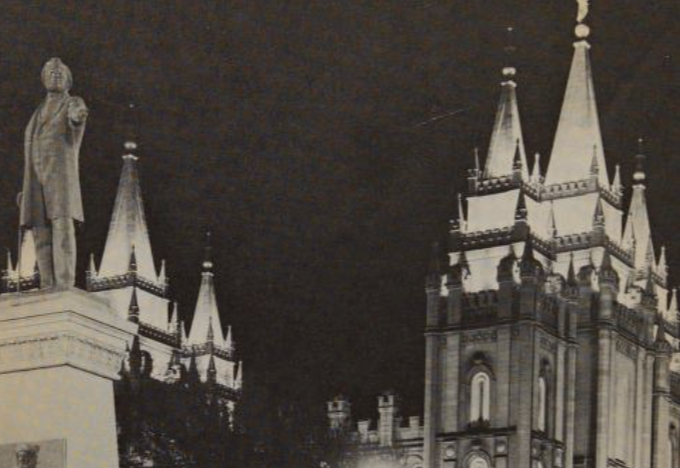
Source: Gordon H. Fraser, The Fields at Home, ed. Peter F. Gunther (Chicago: Moody Press, 1963), 123–34.
GORDON H. FRASER first came into touch with the Mormons in 1932 while doing missionary work under the American Sunday-School Union in western Washington. Since then he has had numerous contacts with the Mormon Church in eastern Idaho, Utah and Arizona. These contacts include presidents of two of the sects of Mormonism. He has had personal interviews with many who have been delivered from Mormonism and with several authorities on Mormon doctrine who are still Mormons. He is author of the book Is Mormonism Christian? published by Moody Press. Mr. Fraser is also founder and president of Southwestern School of Missions among the Indians.
History and Development
MORMONISM HAD ITS GENESIS in the supposed visions of Joseph Smith in Palmyra, New York. On September 21, 1823, the angel Moroni is supposed to have appeared to Smith and directed him to a spot on a nearby hillside where he would find, buried in a cement chest, golden plates on which were inscribed the record of the people who inhabited the American continents in olden times. This record would disclose the “restored gospel.” Smith was indicated by Moroni as the prophet by whom the message would be revealed to the world.1
On the third anniversary of the vision, Smith was permitted to remove the plates together with a device called by Smith the Urim and Thummim, which consisted of prisms mounted in spectacle frames, by means of which Smith was enabled to translate the “reformed Egyptian” characters in which the message was written.
On March 26, 1830, the first edition came from the press,2 where- upon Smith announced himself as “Seer, Translator, a Prophet, an Apostle of Jesus Christ, and Elder of the Church through the will of God and the grace of your Lord Jesus Christ.”
The church was organized April 6, 1830, in the home of Peter Whitmer at Fayette, Seneca County, New York, with six members: three Smiths, two Whitmers and Oliver Cowdery, who had served as Smith’s scribe. Smith and Cowdery ordained each other as the spiritual leaders of the church, and then laid hands on each other to impart the gift of the Holy Ghost. Orson Pratt, an early Mormon theologian, wrote of this event as follows:
Thus was the Church of Christ once more restored to the earth, holding the keys of authority to bind, to loose, and to seal on earth and in heaven, according to the commandments and revelations of Jesus Christ.3
Soon after the founding of the church, Oliver Cowdery and a new convert, Parley Pratt, were ordained to carry the new gospel into the west. They soon found their way to the home of Sidney Rigdon in Ohio and presented him with a copy of the Book of Mormon. Rigdon feigned shocked amazement at the appearance of a “new Bible,” but within a few hours had heralded it as a new revelation. Within a few weeks his entire congregation had been “converted” and baptized into the new sect.
Because of the reputation of the Smith family, the church was unable to thrive in Palmyra or Fayette. Soon after the addition of Rigdon’s flock the entire church moved to Kirtland, Ohio, where headquarters were established and a temple built.
Missionaries were now sent throughout the country and a party pressed westward into Missouri. They reported excellent opportunities for colonization. In July, 1831, Smith and a party went west to investigate and, seeing the beauty and fertility of the country, Smith announced by means of a “revelation” that here, in western Missouri, Zion would be built and God’s kingdom established in the earth.4 The “gentile” Missourians felt otherwise. Almost immediately, trouble began to brew.
By September Smith was again in Kirtland, Ohio, busily engaged in getting a party of settlers off to Missouri to claim the country in the name of the Lord.5
The next few years were spent by Smith in Kirtland, developing the theology of the church and devising what was called the “Order of Enoch.” This had the semblance of a communistic society, which if it had succeeded would have placed all temporal goods in the hands of the church. The church had grown too large and too varied in its membership for this plan to succeed and the idea faded.
A bank was organized with Smith and Rigdon as the managing officers. The state authorities declined to give a charter for the bank, so it was organized as the Kirtland Safety Anti-Banking Society. One hundred and fifty thousand dollars of currency was printed, including Joseph Smith’s famous three dollar bill.6 There were no appreciable assets to back the currency and it was soon selling for twelve and a half cents on the dollar.
It was discovered by certain inquisitive souls that an array of cardboard boxes lining the shelves of the bank office, and each labeled $1,000, contained nothing more valuable than sand, shot and old iron.7 Smith staved off disaster for a while, but because of threats of violence he and Sidney Rigdon left Kirtland on horseback between dark and dawn on January 12, 1838. They headed for Missouri, never again to return to Kirtland.
The first whispers of polygamy were heard about this time. This, together with the financial dealings of Smith, made the Mormons unpopular and another move was indicated.
Meanwhile matters had grown worse in Missouri. Smith and his associates spent considerable time in jail on various charges. Finally, after much feuding and considerable bloodletting on both sides, the “saints” were driven out of Missouri.
A new start was made by the church on the Illinois side of the Mississippi. Nauvoo was built and established as Zion, and a new temple was started but never completed.
Matters were never harmonious in Nauvoo. During the five years that the church remained there, abuses and scandals increased. Factionalism developed, principally because of the polygamy, which was being promoted secretly but denied openly. A faction that had a sharper moral conscience brought the issue to the surface by the publication of an opposition newspaper, the Nauvoo Expositor. Smith was incensed at being thus exposed within his own camp and ordered the press destroyed and the type melted. This was done before a second issue of the paper could be printed, whereupon the state authorities stepped in and ordered Smith’s arrest. Smith managed to hide for a period of weeks, but finally gave himself up and was placed in jail at Carthage, Ill., on charges ranging from disorderly conduct to murder.
A mob stormed the jail on the afternoon of June 27, 1844, overpowered the jailers and broke into Smith’s cell. A gun fight ensued in which Joseph’s brother, Hyrum, was instantly killed and another companion, John Taylor, wounded. Smith, to whom a revolver had been smuggled, fired into the mob, reportedly killing three and wounding two others before he was fatally injured by his assailants.8
The Mormons by now had become completely unwelcome in Illinois, as they had earlier in Ohio and New York. With their prophet dead, they became temporarily demoralized. Several new prophets arose, each armed with a supposed vision, claiming to be successors to the prophet Joseph. Each got a small following and five of these sects still survive, each claiming to be the true church.9
Brigham Young had himself elected president of the church, and dispensing with the necessity of a revelation or a vision, organized the church for its trek westward to Utah. The celebrated “hand-cart march” of the “saints” has been overglamorized by the Mormon historians. Actually it was a debacle of major proportions, in which the poorly equipped and poorly advised migrants perished by the hundreds along the way. It has been estimated that probably one-half the marchers either died of starvation or returned east in disgust. Others continued west and left the church as soon as they were able to do so, joining non-Mormon wagon trains that were bound for Oregon or California.
A hardy group survived and established the church in the valley of the Salt Lake. Brigham Young, ruthless but capable, and surrounded by a small group of devoted henchmen, forged the church into an almost irresistible religio-political organization that in turn had a complete hold on the commerce and banking of the area. Polygamy was now completely unrestrained and the last of Joseph Smith’s “revelations,” Section 132, was made the law of the church in this regard.10
Young died in 1877, but he was capably succeeded by three presidents who had come west with Young and had been companions of Joseph Smith. These were Lorenzo Snow, John Taylor and Wilford Woodruff. Utah was denied statehood because of the practice of polygamy, and finally Wilford Woodruff issued a “manifesto”11 suspending the practice.
With the suspension of polygamy the church grew more rapidly until it achieved its present success.
The church is governed by a president and two co-presidents or counselors. The president presides over a quorum of twelve apostles, who in turn are assisted by a quorum of seventy. The church is divided into “stakes,” which are geographical divisions, each ruled by a president, his counselors, twelve apostles and seventy. The stake is divided into “wards,” each with its president, counselors, twelve and seventy. There is also a system of patriarchs descending in the same order. Their office is to dispense blessings on those who merit them.
At the age of eight children are baptized, at twelve boys become eligible to the office of deacon (the Aaronic priesthood), at eighteen, become eligible to the Melchizedek priesthood. They are then elders and can embark on their tour of duty as missionaries.
It is the plan of the church that every man have an office. When the ward grows to the point where all offices are filled (approximately 250), the ward divides and a new congregation is formed on a geographical basis.
Missionary Efforts
Very little effective missionary work has ever been done among the Mormons. During the early days of Mormonism, 1830-1870, the evangelical bodies were kept busy founding churches as the frontier moved westward. The Mormons were left strictly alone as being unreachable. Then, as now, the churches were satisfied to keep their members from joining the aggressive Mormons.
In 1869 the army marched west to suppress the Mormon threats of rebellion, to give protection to “gentiles” living in Utah, and to prevent such Mormon depredations as the Mountain Meadows Massacre, which had occurred in 1857.12
An army chaplain, Rev. Norman McLeod, was invited to hold services for the few Christians in the Salt Lake area. Sunday schools were started at the army camp and in the city. Dr. John Robinson, an army surgeon, became superintendent of these two efforts.13
McLeod went east to secure missionary support. During his absence Dr. Robinson was waylaid, clubbed to death and a warning sent to McLeod not to return.14 The work was continued by the U. S. district attorney Major Charles Hempstead. The Sunday schools were later absorbed by the Episcopal Church which, in 1867, established the first formal worship in the territory under the direction of two clergymen, Thomas W. Haskins and George W. Foote.
The Episcopalians had little success with the Mormons, but did maintain a foothold for the Christian forces in Salt Lake. A later clergyman, Bishop F. S. Spalding, made a lasting contribution to the enlightenment of the public in his publication of the paper, Joseph Smith Jr. as a Translator,15 which is a potent exposé of the ridiculous claims of the Mormons’ sacred book, The Pearl of Great Price. This Joseph Smith claimed to have translated from papyri found on an Egyptian mummy purchased from a traveling showman named Chandler.16
In 1869 two Presbyterian missionaries, Sheldon Jackson and Melanchthon Hughes, held their first service at Corinne, Utah, and a church with nine members was organized in 1870. The Presbyterians in Salt Lake City pleaded for help, and in 1871 Rev. Josiah Welch arrived. He held services in a room over a livery stable.17 This was the start of an aggressive missionary effort which resulted in the conversion of many Mormons and the establishment of over forty missions within a decade.
As the territory became populated by non-Mormons, the church gradually transferred its efforts to the newcomers, so that by the beginning of the new century the missionary phase of their work diminished. The Mormons by this time had achieved a degree of respectability with the outlawing of polygamy and were experiencing tremendous growth. The tide turned against the Protestant churches, and of the more than fifty Presbyterian churches of the 1880’s, not more than ten have survived.
The Baptists came to Utah in 1881.18 While their testimony was a positive one, they had only nominal success among the Mormons. They have shared the fate of the Presbyterians.
The first and only extensive work directed solely toward the conversion of the Mormons was that of the Utah Gospel Mission. This was headed by John D. Nutting, who labored for fifty years in Utah and Idaho. Nutting and his associates worked through the country as itinerant missionaries using horse-drawn gospel wagons, and finally Model T Fords. These men worked in teams of two, adopting the tactics of the Mormons. Hence they were respected, if hated, and made considerable headway. It was difficult to recruit missionaries for this difficult work and with the retirement of Nutting the work was finally discontinued.19
One hardy character of this period, probably either an associate of Nutting or one of the Presbyterians, has become a legend. He was Rev. Duncan McMillan, who preached with an American flag draped over a dry-goods box for a pulpit, with his Bible on one side and a six-shooter on the other.
At the present time only two organized efforts are being directed toward the conversion of the Mormons. One of these, the Utah Christian Tract Society, has as its directors Mr. and Mrs. Arthur Budvarsen and as its field missionaries Mr. and Mrs. Einar Anderson. All are converted Mormons.20 The other is the Christian Tract Society, directed by Mr. and Mrs. Harry McGimsey.21
Both societies major in a printed-page ministry, using highly specialized literature. The Utah Christian Tract Society has a special ministry in reaching those who are in danger of being ensnared in the Mormon cult. They carry on an extensive correspondence work both with Mormons and those threatened by Mormonism. Mr. McGimsey’s work is in literature distribution carried on by personal contact. Together with volunteer workers he covers the Mormon Church conventions in Salt Lake City and other Mormon gatherings wherever possible. His teams also do the visitation work in the solidly Mormon towns of the mountain area.
Methods of Dealing with Mormons
In approaching evangelical work among Mormons, two distinct methods must be considered. Each of these calls for different methods and preparation.
The most urgent need is that of salvaging those who are in the process of being indoctrinated by the Mormons. Since most of these are members of Protestant churches, it will be seen that this is largely the task of local pastors and their personal workers.
The urgency of this need will be evident when one realizes that some 15,000 Mormon workers have, at all times, an estimated 500,000 inquirers under weekly indoctrination.
These inquirers are usually the infrequent attenders at church services, and their defection will often remain undetected until it is too late. They are often attracted by the sincerity and friendliness of the Mormon missionaries and will come to their defense when approached by their pastor or a Christian worker. They will also usually insist that the Mormon instructors be present at any interview, which makes it necessary for the Christian worker to be prepared to deal not only with the defecting church member but with a shrewd, ruthless and calculating Mormon teacher who is a past master in the art of argument and evasion. The Mormon worker is trained in the knowledge of the doctrines and phraseology of the denomination involved. This is a deliberate tactic that is studied carefully in the Mormon training program.
As soon as Mormon missionaries are detected in a given area, the churches should immediately be alerted, as the missionaries are never sent into an area unless the church estimates that a Mormon congregation can be recruited. They always seek to proselyte their members rather than to draw them from the unchurched population.
If possible the evangelical churches should join in a campaign to alert their members and to instruct their workers in methods of dealing with the problem. If possible, a worker thoroughly familiar with Mormon doctrine and practices should be asked to hold instruction classes. A canvass should then be made to ascertain which of the members are being visited by the Mormons. Suitable literature should be distributed liberally throughout the area. Such literature is available from the tract societies mentioned.
In dealing with Mormons themselves there is no substitute for persistent, repeated calling on individuals and families. It may take months of such calling to win an individual from Mormonism. Since this is the method used by the Mormons, it is the only method they will respect. It is usually purposeless to get them to attend public services.
Suitable tracts will often arouse their interest and gain an opening, but these must be followed by personal visitation, since the average Mormon is so completely insulated against “gentile” doctrines that he will obstinately resent the suggestion that there is any “gospel truth” other than his own.
It is impossible, in the space allotted, to go into a detailed discussion of the lengthy process of dealing with the various types of individual cases. In lieu of this, the Christian worker should make a thorough study of the Christian doctrines for which the Mormons have a corresponding doctrine, bearing in mind that the Mormon has a carefully worded statement, in the language of orthodoxy, to cover each of his doctrines.
The worker should be thoroughly familiar with the Mormon sacred books,22 bearing in mind that when a Mormon quotes “scripture” he will blend Bible verses with quotations from his own scriptures.
The worker should be familiar with the gross discrepancies of the Mormon books to realize that their books are contradictory within themselves.23 This is a vulnerable point with the Mormons. The worker should be familiar with the history of Mormonism.24 The Mormon is very proud of his history, but in the case of many Mormons, this is due to the fact that he has had only the Mormon version of the stories of Joseph Smith and Brigham Young.
If the Mormon can be made to question the veracity of his sacred books and the impeccability of his prophet, he is half won.
There is much literature on the subject, but unfortunately it has not been produced by the Christian press. A small start has been made in this field by Christian writers. The bibliography appended will serve as a guide. Since the Mormons make it a practice to seek out and destroy books unfavorable to them, it is a good habit to accumulate a small library on the subject for future reference. Some volumes have now become almost unavailable because of this practice of the Mormons. This is true of library books as well as those in used bookstores. The writer and his associates are accumulating a library of Mormon paraphernalia so that it may be available for research.
Bibliography
Helps for Christian Workers
- Fraser, Gordon H. Is Mormonism Christian? Chicago: Moody Press, 1957.
- Light on Mormonism. Cleveland: Utah Gospel Mission.
- Spaulding, F. S. Joseph Smith as Translator. Private printing.
History of Mormonism
- Brodie, Fawn M. No Man Knows My History. New York: Alfred A. Knopf, Inc., 1945.
- Evans, John Henry. Joseph Smith, An American Prophet. New York: The Macmillan Co., 1933.
- Howe, E. D. Mormonism Unveiled. Published by author in 1840. Rare.
- Kidder, Daniel P. Mormonism and the Mormons. 1842. Rare.
- Lee, John D. The Mormon Menace. Printed privately. Rare.
- Linn, William A. Story of the Mormons. New York: The Macmillan Co., 1902.
- Holy Murder, The Story of Porter Rockwell. New York: Kelly & Birney, 1934.
Mormon Works
- Doctrine and Covenants. Salt Lake City: Deseret Book Store.
- History of the Church of Jesus Christ of Latter Day Saints, 8 Vols. Salt Lake City: Deseret Book Store.
- Pearl of Great Price. Salt Lake City: Deseret Book Store.
- King Follett Discourse. Salt Lake City: Zion’s Book Store.
- Smith, Joseph. Book of Mormon. Salt Lake City: Deseret Book Store, 1920.
References
- Pearl of Great Price, p. 59. ↩︎
- Printed by E. B. Grandin, Palmyra, N. Y. ↩︎
- B. Stenhouse, Rocky Mountain Saints (London: Ward, Lock & Tyler, 1874), p. 32. ↩︎
- Doctrine and Covenants, Sec. 57. ↩︎
- Ibid, Sec. 64:26. ↩︎
- Fawn M. Brodie, No Man Knows My History (New York: Alfred A. Knopf, Inc.), pp. 195–198. ↩︎
- Ibid., pp. 196, 197. ↩︎
- History of the Church (Mormon), IV, 617, 618; John D. Lee, The Mormon Menace, p. 195. ↩︎
- Gordon H. Fraser, Is Mormonism Christian? (Chicago: Moody Press), pp. 9–11. ↩︎
- Doctrine and Covenants, Sec. 132. ↩︎
- Ibid., following Sec. 136. ↩︎
- Schaff-Herzog Encyclopedia, 1953 ed. VIII, 17. ↩︎
- Ibid., p. 20. ↩︎
- Ibid.; Holy Murder (Kelly & Birney), pp. 228–230. ↩︎
- F. S. Spalding, Joseph Smith, Jr. as a Translator. ↩︎
- Fawn M. Brodie, No Man Knows My History, 1953 ed., VIII, 20, New York: Alfred A. Knopf, p. 176. ↩︎
- Schaff-Herzog Encyclopedia, 1953 ed. VIII, 17. ↩︎
- Ibid. ↩︎
- Light on Mormonism (Utah Gospel Mission). ↩︎
- Utah Christian Tract Society, Box 725, LaMesa, Calif. ↩︎
- Christian Tract Society, P.O. Box 1311, Phoenix, Ariz. ↩︎
- The Book of Mormon; The Pearl of Great Price; Doctrine and Covenants. ↩︎
- Gordon H. Fraser, Is Mormonism Christian? (Chicago: Moody Press), pp. 17, 19. ↩︎
- Fawn M. Brodie, No Man Knows My History (New York: Alfred A. Knopf). ↩︎