

Bible retail sales hit record numbers in 2025, with Circana BookScan reporting that the year “marked a 21-year high for Bible sales in the U.S.” with 19 million units sold. This is an increase of 12 percent for 2024 and double the number sold in 2019!
The Church of Jesus Christ of Latter-day Saints is now encouraging the reading of the Bible in translations other than the traditional King James Version (KJV). A change to the “General Handbook: Serving in The Church of Jesus Christ of Latter-day Saints” was announced on December 16, 2025 on the LDS Church “Newsroom” website. The article reporting on the change explains how some members “may benefit from translations that are doctrinally clear and also easier to understand.”
It went on to say that “members should use a preferred or Church-published edition of the Bible in Church classes and meetings,” which is the King James Version of the Bible. However, Protestant Bible translations are now being encouraged so that church members can “better understand the teachings of the Hebrew Bible and the New Testament.”
Is there a “best” translation?
Many ask, “What is the best modern Bible translation?” This can be a hotly debated topic as there are many opinions. While there is no “perfect” translation of the Bible (or any other book, for that matter), it is possible for people to have favorites based on, among other things, their church backgrounds and personal preferences.
Scholars Vern Poythress and Wayne Gruden describe the importance of an accurate Bible translation:
“The Bible is God’s own Word to us. We depend on it for instructing us about the crucial issue of salvation. ‘What must I do to be saved?’ (Acts 16:30). We depend on it to guide us in the right way to live: ‘Your word is a lamp to my feet and a light for my path’ (Psalm 119:105). We depend on it for revealed Jesus Christ to us: ‘These things are written that you may believe that Jesus is the Christ, the Son of God, and that by believing you may have life in his name’ (John 20:31). So it is surpassingly important that the Bible be translated accurately” (The Gender-Neutral Bible Controversy: Muting the Masculinity of God’s Words, Boardman and Holman, 2000).
The LDS Church has recommended six different translations that, as the article states, help “achieve both readability and doctrinal clarity.” They are as follows:
Ages 8 and above:
New International Reader’s Version (NIrV)
Ages 11-13:
New International Version (NIV)
New King James Version (NKJV)
Ages 14 and above:
English Standard Version (ESV)
New Revised Standard Version (NRSV)
With that in mind, let’s take a closer look at each of these translations, including its rendering of the often-cited John 3:16-17. We can also consider some of the strengths and weaknesses of each translation.
Note: We will give the sales ranking of Bibles from the Evangelical Christian Publisher Association from 2025 to give an idea of the popularity of each translation.
New International Reader’s Version (NIrV)
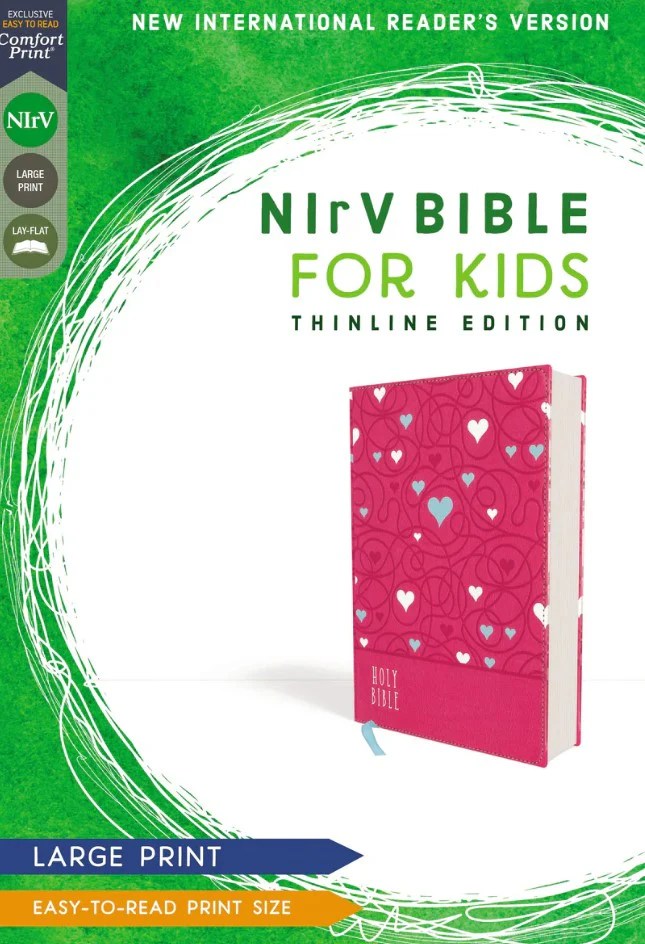
This translation was written at a third grade reading level. Thus, it is aimed at children and English as a Second Language readers. Indeed, the version emphasizes simple words and short sentences. The NIrV was translated by 40 translators and produced by the International Bible Society (now Biblica) in 1996; the translation was revised in both 1998 and 2014. It was the tenth most popular selling version in 2025.
All in all, this is an easier-to-understand version than the New International Version because it is purposely written in a simpler fashion, though often using the 1984 NIV verbatim in some cases. The five fundamentals used by the translators were: 1) Readability; 2) Understandability; 3) Compatibility with the NIV; 4) Reliability; 5) Trustworthiness. The goal was to get readers to eventually graduate to the regular NIV when the right time comes.
The original 1996 edition used gender inclusive language, but in 1998 it returned to traditional gender language. It then went back to gender inclusive language in 2014. For instance, Mark 4:25 in the ESV reads, “For to the one who has, more will be given, and from the one who has not, even what he has will be taken away.” In the NIrV, it says, “Whoever has something will be given more. Whoever has nothing, even what they have will be taken away from them.”
Consider the differences in 1 Timothy 3:16 between the NIV and the 2014 NIrV:
NIV: Beyond all question, the mystery from which true godliness springs is great:
He appeared in the flesh,
was vindicated by the Spirit,
was seen by angels,
was preached among the nations,
was believed on in the world,
was taken up in glory.
NIrV: There is no doubt that true godliness comes from this great mystery.
Jesus came as a human being.
The Holy Spirit proved that he was the Son of God.
He was seen by angels.
He was preached among the nations.
People in the world believed in him.
He was taken up to heaven in glory.
The NIrV translates John 3:16-17 as follows:
16 God so loved the world that he gave his one and only Son. Anyone who believes in him will not die but will have eternal life. 17 God did not send his Son into the world to judge the world. He sent his Son to save the world through him.
Strengths:
- Lowest reading level for any of the Bible recommendations. (Notice the short sentences used in the John 3 passage cited above.)
- A simple read for those who have limited understanding of English.
Weaknesses:
- Probably not best for most native English speaking adults who can read at a sixth grade or higher level.
- The easier the translation, the more that is certainly missing from the original text–something to keep in mind.
Conclusion
Out of all the translations listed by the LDS Church, this is the easiest to understand and would best be suited for younger/ESL readers. For adult readers, there are better choices and thus I would not recommend it for anyone in high school or above.
New International Version (NIV)

The NIV is the top-selling English Bible today. And for good reason. With the exception of the NLT discussed below, the NIV is the easiest reading adult Bible out of those that were recommended by the LDS Church. It is written at a seventh grade level using a thought-for-thought philosophy rather than word-for-word philosophy utilized by the ESV, the New American Standard (NASB), and the NKJV.
The strategy is called “dynamic equivalence,” which means that the translation puts the meaning into words that can stray from the literal meaning. It smooths out unclear nuances and takes the general guesswork out of what a passage means. The criticism some have of the NIV is they feel sometimes too much interpretation is made, thus missing the passage’s more literal meaning.
The NIV was first produced in 1978 and then revised in 1984. A second revision, more controversial in nature, took place in 2011. It was originally published by the New York Bible Society, now known as Biblica.
A criticism by some conservative believers is that the newest edition uses gender inclusive language.
Example: 1 Timothy 2:4 said in the 1984 version, “[God] wants all men to be saved.” In the 2011 edition, “men” was changed to “people” because the Greek word (anthropos) does not literally mean a male gender but those from both genders. A total of five percent was affected by word changes in the newest edition.
I think that the NIV’s insistence to use dynamic equivalence can end up causing more problems. For instance, in John 6:44, the 1984 NIV said, “No one can come to me unless the Father who sent me draws him, and I will raise him up on the last day.” The 2011 version says, “No one can come to me unless the Father who sent me draws them, and I will raise them up at the last day.”
The point of the verse is that Jesus will raise up the individual, not a group of people. By using the third person plural pronoun when the third person singular pronoun is in the original, I think the NIV does a disservice and makes this more complicated than it should be. Oher examples can be shown to explain why I prefer the 1984 edition over the 2011.
Initially, the changes were made in a completely different edition called Today’s New International Version (TNIV). The project began in 1997, with the New Testament released in 2002 and the complete Bible in 2005. It did not catch on as hoped, so many of the TNIV changes were later incorporated in the 2011 edition.
The NIV translates John 3:16-17 as follows:
16 For God so loved the world that he gave his one and only Son, that whoever believes in him shall not perish but have eternal life. 17 For God did not send his Son into the world to condemn the world, but to save the world through him.
Strengths:
- While not as literal as other popular translations, the NIV generally stays close to the original text while making it understandable for a contemporary audience.
- It is the most popular selling Bible on the market today and is used in a mixture of Evangelical denominations.
Weaknesses:
- Some dislike the general inclusive changes made in 2011. Yet, unlike the 1995 to 2020 NASB editions described below, it’s hard to find new copies of the older edition for sale—those who don’t like the revisions don’t have many options except to search for used copies on the Internet.
- Others may feel that the NIV takes too many liberties with the text and sacrifices the meaning merely to make the text more readable.
Conclusion
In my opinion, this and the ESV are the best two possibilities for a modern reader of the Bible. Some will disagree with my liking the NIV, but I have used the 1984 for four decades and have memorized hundreds of verses of scripture—even chapters—with this translation. I feel it does a good job conveying the meaning in a contemporary way the average person can understand.
New Living Translation (NLT)

Written at a sixth grade level, the New Living Translation (NLT) is a thought-for-though translation started in 1989 and published in 1996, revised in both 2004 and 2015. It is the fourth most popular selling English Bible. A total of 87 translators worked on this for Tyndale House Publishers. The goal was to provide an easy-to-read translation for 21st century readers.
The NLT is an extensive revision of Kenneth Taylor’s Living Bible, a one-man paraphrase from the American Standard Version of 1901 originally published in 1971 by Tyndale. (This was my translation for several years when I attended a Lutheran church in my youth.) According to the publisher, the translators decided to fully revise instead of merely reformatting Taylor’s version, a decision approved by Taylor.
One criticism is that theological words were simplified in the translation. For example, the word “justification” is taken out of Romans 5:1 to read, “Therefore, since we have been made right in God’s sight by faith…” Yes, a difficult word was eliminted, but “justification” means more than just being “made right.” It involves a legal declaration given by God who declares believers righteous. This does not appear to be a good trade.
The NLT translates John 3:16-17 as follows:
16 For this is how God loved the world: He gave his one and only Son, so that everyone who believes in him will not perish but have eternal life. 17 God sent his Son into the world not to judge the world, but to save the world through him.
Strengths:
- Easy to read and understand—simpler than any other version suggested by the LDS Church except the NIrV.
Weaknesses:
- The translation can be loose and move away from the literal meaning.
- Important theological terms are eliminated, which is unfortunate.
Conclusion
For those who struggle with English because of age or are not native speakers, this version can certainly work. But the thought-for-thought translation can sometimes mean that precision is sacrificed. This is a do-able translation, but it’s not one I generally recommend.
New King James Version (NKJV)

Out of all the versions recommended, this word-for-word translation (along with the New American Standard Bible) is the most literal. It is aimed at a ninth grade reading level by 119 translators commissioned by Thomas Nelson Publisher.
The NKJV is based on the King James Version (KJV) from 1769 (originally written in 1611), which was mainly based on William Tyndale’s 16th century translation—estimated to be 84% of the New Testament and 75% of the Old Testament in the original KJV. Other translations utilized in the initial version included the 16th century Bishop’s Bible, the Tavener Bible, and the Geneva Bible.
The NKJV translators intended to create a more modern rendering of the KJV while keeping the structure and beauty of the beloved version. Thus, the archaic “thees” and “thous” and words ending in “eth” and “est” are all eliminated. Words that distort the meaning are also changed, including James 5:11, which says that “the Lord is very pitiful.” This was changed in the NKJV to “the Lord is very compassionate and merciful.” (Thank goodness!)
Or the reference to a man wearing “gay” clothes in James 2:3 was changed to “fine” clothes. Today the NKJV is the fifth most popular selling version, with the KJV at the third best selling spot.
The Old Testament Masoretic Hebrew text and the Textus Receptus Greek text from 500 years ago are used; the version generally does not take full advantage of more modern manuscript discoveries. Still, for some “fundamentalists,” even making any changes to the adored KJV are despised.
One critic dramatically wrote that the NKJV “changed thousands of words, ruined valuable verses, and when not agreeing with the King James Bible, it has instead copied the perverted NIV, NASV or RSV. And this you must know: those who translated the NKJV did not believe God perfectly preserved His words!” In other words, even a conservative translation like the NKJV can be attacked by the wrong crowd.
The NKJV translates John 3:16-17 as follows:
16 For God so loved the world that He gave His only begotten Son, that whoever believes in Him should not perish but have everlasting life. 17 For God did not send His Son into the world to condemn the world, but that the world through Him might be saved.
In contrast, this is how the KJV translates those verses this way:
16 For God so loved the world, that he gave his only begotten Son, that whosoever believeth in him should not perish, but have everlasting life. 17 For God sent not his Son into the world to condemn the world; but that the world through him might be saved.
Strengths:
- Cleans up some of the archaic words and phrases that make the KJV unreadable for many.
- Very literal rendering of the biblical languages.
Weaknesses:
- Does not take full advantage of manuscript discoveries over the past four centuries.
- Relies almost completely on merely modernizing the KJV from centuries ago.
Conclusion
Perhaps I am too critical. Indeed, I would prefer Latter-day Saints read the NKJV over the KJV. Getting rid of the archaic wording is an incredible help to help make the Bible more understandable. If this is most acceptable to a Latter-day Saint, then I would say start here. But when there are more readable versions recommended by the LDS Church, the NKJV would not be my first choice.
English Standard Version (ESV)

This second most popular selling translation (after the NIV) written to an 8th grade level is the ESV, a formal equivalence translation published by Good News/Crossway. The 1971 Revised Standard Bible (created by the liberal National Council of Churches) was used as its base to create a more modern, readable, and yet literal translation in the lines of the Tyndale Version of 1535 and the 1611 KJV.
After a 1979 meeting was called by Focus on the Family’s James Dobson to encourage a better Bible translation, the version was commissioned and then created by more than 100 translators a few years later in 2001. Theologian J.I. Packer was the chief editor of the project with a goal of “essentially literal.”
Theological terms play an important role in the ESV, including justification, sanctification, regeneration, redemption, and the like—instead of moving these terms to something more simple, the ESV requires its readers to do a little study on their own. Inclusive language does not play a role in the ESV. For example, when the word “brothers” is used in a verse, the word “sisters” is not added. Instead of “they” referring to a singular pronoun, “he” is used when referring to the masculine. And the word “sons” is used when the adoption/inheritance laws of Rome were referenced.
Because it is looking to translate using a literal model while making the translation applicable to a 21st century audience, this translation is especially popular with more conservative Evangelical Christian audiences. The version is easier to understand than the NASB, which is also a literal translation but not specifically recommended by the LDS Church.
Sometimes, however, the ESV renderings can cause me to scratch my head. For example, recently I read the story of Sennacherib invading Judah in Isaiah 36. Verse 4 reads, “And the Rabshakeh said to them…” The NIV does not use “Rabshakeh,” which is a word for the field commander. I doubt many would know what the title “Rabshakeh” is since this is not a person’s name. (To be fair, the other adult versions recommended by the church also use “Rabshakeh,” so the ESV is not unique.) It is an issue like this that makes me wonder if there are other places the ESV unnecessarily confuses its readers.
The ESV translates John 3:16-17 as follows:
16 “For God so loved the world, that he gave his only Son, that whoever believes in him should not perish but have eternal life. 17 For God did not send his Son into the world to condemn the world, but in order that the world might be saved through him.
Strengths:
- Does not divert far from the literal text and is a good Bible to study from.
- With a few exceptions, it is generally quite readable.
Weaknesses:
- Sometimes clarity is sacrificed for the goal of being literal.
- Can be sometimes a bit unwieldy and hard to understand in certain places for a modern audience.
- Uses the RSV as its base, which is by no means a conservative Bible.
Conclusion
Many conservative churches use the ESV, so there is a good chance your local church will be reading this version in their service. A person choosing the ESV is going to have a much better understanding of biblical truth than, say, the KJV or the NKJV. It is a good choice for many who are coming from a King James Version background.
New Revised Standard Version (NRSV)

First published as a revision of the Revised Standard Version (1952), the NRSV was put together in 1989 by 30 translators who belonged to the Orthodox, Jewish, Catholic and liberal Protestant denominations. In 2021, the New Revised Standard Version Updated Edition (NRSVue) was published. The NSRV is the ninth most popular selling version.
It was produced by the Division of Christian Education and the progressive (liberal) National Council of Churches, a conglomeration of typically mainline denominations. It is commonly used by Episcopalians, Presbyterians, and some Catholics as an ecumenical Bible, using a mixture of word-for-word and thought-for-thought. The publisher describes the philosophy “as literal as possible, as free as necessary.” It is best for academic study.
The intent was to produce a scholarly version that incorporated newly found manuscripts, including the Dead Sea Scrolls. Language had changed between 1952 and the 1980s. For example, the RSV had God saying in Psalm 50:9, “I will accept no bull from your house.” In the 1950s, this was a reference to an animal that would be brought forth in sacrifice. However, the meaning had changed. The translators now have that verse say, “I will not accept a bull from your house.”
The translation uses gender inclusive language in reference to humanity, but to its credit, it keeps masculine pronouns for God. In the NRSV Common edition, the apocrypha is placed between the Old and New Testaments in this translation, the only one of the six translations to do so.
The translation of the following two verses does show a bias toward the morality of homosexual behavior. Consider the ESV’s rendering of 1 Timothy 1:10:
the sexually immoral, men who practice homosexuality, enslavers, liars, perjurers, and whatever else is contrary to sound doctrine
In the NRSV, a change was made to read “men who engage in illicit sex.” A note says the “meaning of the Greek is uncertain.” The word “homosexuality” is used in every other edition recommended by the LDS Church.
In 1 Corinthians 6:9-10, the ESV reads,
9 Or do you not know that the unrighteous will not inherit the kingdom of God? Do not be deceived: neither the sexually immoral, nor idolaters, nor adulterers, nor men who practice homosexuality, 10 nor thieves, nor the greedy, nor drunkards, nor revilers, nor swindlers will inherit the kingdom of God.
In the NRSV, it replaces “nor men who practice homosexuality” with “men who engage in illicit sex,” using the same footnote. These changes seem to eliminate homosexuality as a “sin” because “illicit sex” can be taken in other ways.
Bias is also shown in 1 Timothy 3:2 that says an elder must be the husband of one wife. The NRSV changed it to a bishop who must be “married only once,” taking away the idea that elder/bishop is in the masculine as a reference to a male leader. Perhaps this was done to appease the many denominations using this translation who believe in female pastors.
The NRSV translates John 3:16-17 as follows:
16 “For God so loved the world that he gave his only Son, so that everyone who believes in him may not perish but may have eternal life. 17 “Indeed, God did not send the Son into the world to condemn the world but in order that the world might be saved through him.
Strengths:
- Scholarly and generally literal.
Weaknesses:
- Some bias is shown in the translation and seems to give in to more progressive philosophy.
- Not translated by conservative Evangelical scholars—was more created for those attending liberal Protestant denominations as well as Catholics and Orthodox.
Conclusion
Out of the six translations suggested by the LDS Church, this is my least favorite choice. There are too many places where presuppositional bias can come out in the translation, causing me as a reader to doubt what the NRSV says. The average reader will benefit more from the ESV or NIV.
My Rating of the Recommended Bibles
The question at hand is “which translation is best.” As I said earlier, this is a question of opinion. But since you asked, here is the order I would put the translations into:
- ESV
- NIV
- NIrV (for children/ESL)
- NKJV
- NLT
- NRSV
I give the ESV the nod for the top spot, though if the decision was between the ESV and the 1984 NIV, then NIV would win–it’s certainly my favorite version!
The dynamic equivalence issue will cause a problem for many Evangelical Christians, but except for the ESV and KJV/NKJV, the other three translations in the recommended list are all dynamic equivalent. Personally, I understand why those versions use it, but back in the day, we all knew that women were included in the cases where masculine pronouns were used.
Honestly, I think the average reader will benefit most from the first two selections while children and ESL readers are best paired the NIrV or the NLT. Meanwhile, the NRSV is generally not a translation I can recommend—but hey, if this version is helpful to a Latter-day Saint to understand the general principles of the Bible, I will not say this translation shouldn’t be used. If the New World Translation produced by the Watchtower Bible and Tract Society (Jehovah’s Witnesses) had been recommended—or, for that matter, Joseph Smith’s Inspired Version called the Joseph Smith Translation—then either of these two would have been on the bottom of the list.
Which reputable versions were left out?
In the Newsroom article, it is clearly stated that “the list comprises (but is not limited to)” the six translations that were named. Thus, a Latter-day Saint could choose another version and still feel authorized to use it. Are there translations that might be worth a look? Let’s take a look at two other possibilities that are both considered strong choices.
New American Standard Bible (NASB)

First published in 1971 and then revised in 1995 and 2020, the NASB is known for being a strict word-for-word translation, even more literal than the ESV or NKJV. Some critics may say it is “wooden” (stilted or unwieldy would be similar words) and sometimes the meaning is hard to decipher.
A total of 58 translators partook in the first edition in 1971 from a variety of denominational backgrounds, including Southern Baptists and a variety of mainline denominations such as Methodist, Presbyterian, and Baptists. All of the scholars, though, were conservative with doctorates in biblical languages and theology. Today the NASB is the eighth most popular selling Bible—though it is unclear if this is referring to the 2020 newest edition or the 1995 previous edition, which is still sold.
Written to an eleventh grade audience, the NASB was originally put together in 1971 by the Lockman Foundation to remove antiquated phrases from previous translations and to add modern punctuation. Modern manuscript discoveries, including the Dead Sea Scrolls, were utilized in the translation as well. Pronouns referring to God and Jesus were capitalized. (Personally, I like this strategy to identify references to deity, even though there is no capitalization in the original languages!)
In 1995, 20 scholars made changes to the first edition to enhance clarity and readability while keeping the text readable. “Thee’s,” “ye’s” and “thou’s” that had been in the original text were switched to more modern “you” while fewer sentences began with “and.”
There was some controversy with the latest update in 2020 to make the reading more smooth and readable. Yet with changes being made to 75 percent of the verses, the newest edition comes across as slightly less literal, causing some NASB purists angst. Also, some gender-accurate language is used in the latest update, though “and sister” in “brother and sisters” is listed in italics to show it is not in the original text. Unlike the 2011 NIV, the “singular they” is not used, but rather “him.” Because of the controversy, the publisher still sells the 1995 edition alongside the 2020 version.
The 1995 NASB translates John 3:16-17 as follows:
The 2020 NASB translates these verses as follows:
16 “For God so loved the world, that He gave His only Son, so that everyone who believes in Him will not perish, but have eternal life. 17 For God did not send the Son into the world to judge the world, but so that the world might be saved through Him.
Strengths:
- Literal—as literal as it gets.
- Very accurate with the original meaning of the text.
Weaknesses:
- Because it is so literal, it can be more difficult to read than the versions that have been recommended by the LDS Church.
Conclusion
The NASB is a solid translation. Perhaps it was not named as one of the possible choices by the LDS Church because they may not have wanted to enter the fray between the 1995 and 2020 versions. The 2020 version did eliminate some of the clunkiness of the 1995 version—though it did make a lot of readers unhappy.
Still, I choose either the 1995 or 2020 editions just behind the ESV and NIV as a reputable translation and think a Latter-day Saint won’t go wrong with it.
Christan Standard Bible (CSB)

The Christian Standard Bible was originally published as the Holman Christian Standard Bible in 2004 and revised as the Christian Standard Bible in 2017 by the Southern Baptist publisher Holman. There were more than 100 translators from 17 different denominations—including Baptist, Lutheran, Presbyterian, conservative Anglican and non-denominational churches—to produce a Bible written at a simple seventh grade level; the revision was done by a group of 21 conservative scholars.
Some changes in 2017 included rendering YHWH–known as the Tetragrammaton–as LORD rather than Yahweh in the original; in addition, the pronouns for God are no longer capitalized. Like the NASB, the CSB uses the singular “him” rather than “they” as the NIV from 2011 does. Another update was made in 2020, though it only affected the 2017 text while focusing mostly on footnotes, cross references, punctuation and word/phrase choices.
The CSB uses what it calls “optimal equivalence” to “incorporate advances in biblical scholarship and input from Bible scholars, pastors, and readers to sharpen both accuracy and readability.” It uses “humans” rather than “men” in parts where the word “anthropos” does mean male—something done in other Evangelical translations as well. Some have criticized the translation because it tends to lean toward a complementarian view of women in the church rather than egalitarian (equality of husbands and wives) based on how some verses are translated.
The CSB translates John 3:16-17 as follows:
16 For God loved the world in this way: He gave his one and only Son, so that everyone who believes in him will not perish but have eternal life. 17 For God did not send his Son into the world to condemn the world, but to save the world through him.
Strengths:
- Generally literal, though not as literal as NASB and NKJV.
- Conservative in the translation.
Weaknesses:
- Linked closely with the Southern Baptists (though unfair because a number of scholars from other denominations took place in the translation).
Conclusion
Here is another good translation that, like the NASB described above, I’d put just under then ESV and NIV. You can’t go wrong here and the scholarship is conservative and can be trusted. I highly recommend this version as well.
Legacy Standard Bible (LSB)

The LSB was published in 2021 by Three Sixteen Publishing—sponsored by the John MacArthur Charitable Trust—in partnership with the Lockman Foundation. It is a revision of the 1995 edition of the NASB translated by various faculty from The Master’s Seminary, with more than 70 scholars and pastors, and everyday readers participating.
It is, as the publisher writes, a translation that “honors and upholds the NASB tradition, and endeavors to more fully implement its translation philosophy.” Any changes made from the NASB were done to give “greater consistency in word usage, accuracy in grammatical structure, and tightening phrasing.”
One change from the NASB is to change “LORD” or “GOD” in all capitals in the Old Testament to “Yahweh” or “Yah” depending on the original. In addition, the LSB uses “slave” for the Greek word “doulos,” which was mostly done in the NASB but not completely. Most translations will use the more politically correct “servant” instead. Meanwhile, the LSB follows the NASB’s use of capitalization for any pronoun referencing God, Jesus, and the Holy Spirit.
The LSB translates John 3:16-17 as follows:
16 “For God so loved the world, that He gave His only begotten Son, that whoever believes in Him shall not perish, but have eternal life. 17 For God did not send the Son into the world to judge the world, but that the world might be saved through Him.
This translation of the verse is the same as the 1995 NASB, as no changes were made.
Strengths:
- Literal, just as the NASB from which it is generally taken.
- Perhaps a good graduation from the 1995 NASB—in contrast to the 2020 NASB that has been criticized for too many changes.
- Faithful to the original text.
Weaknesses:
- If you don’t like the 1995 NASB, you won’t like this.
- Does this version have too much influence from Reformed pastor John MacArthur? Some think so.
Conclusion
I honestly have not read the LSB at length. However, it appears to be a solid translation and may be a good replacement for the 2020 NASB (for those who don’t like that). To improve on an already good version (NASB) is a mark of integrity and I think this could be a good pick.
So where can someone get these modern translations?
With all of this said, please note that the reader doesn’t have to purchase a Bible in order to read these different translations. Here are some online resources. Try these out and read the versions talked about in this article:
A variety of all editions of the Bible are found at the Utah Christian Research Center in Draper, UT. We are open Wed-Sat each week and have personnel there to help you find just the right Bible for you! Come visit us!
Now, go out and get a modern translation of the Bible. And start reading!
You must be logged in to post a comment.