
On November 1, 1831 Joseph Smith convened a conference of ten Mormon elders. The agenda for the meeting was to make decisions regarding the publication of Joseph’s revelations. According to an article in Mormon Times,
“Joseph said that since the Lord had given the great blessing of so many revelations, the elders should decide what testimony they were willing to attach to the book. After several present arose and said they were willing to testify to the world, Joseph prepared a statement for the witnesses to sign. The contemporaneous minutes described it as a revelation.”
However, some of the “potential witnesses” had doubts about some of the revelations. They were not prepared to testify to the truthfulness of Joseph’s revelations until God confirmed it. Before they would sign their names, they wanted a spiritual witness similar to that which had been reported by the Book of Mormon witnesses. “The conference was deadlocked.”
But then Joseph received a revelation (Doctrine and Covenants 67). Mormon Times reports,
“The Lord gave a challenge for the elders to choose the ‘least’ of Joseph’s revelations and then choose the ‘most wise among you’ to see if he can write a similar one. If he could, then their reticence over the language was justified. If not, ‘ye are under condemnation if ye do not bear record that they are true’”
Nobody was able to write a revelation on par with Joseph’s, so five elders (and later thirteen others) signed their names to the document, which read in part,
“We, the undersigners, feel willing to bear testimony to all the world of mankind, to every creature upon the face of all the Earth and upon the islands of the sea, that God hath borne record to our souls, through the Holy Ghost shed forth upon us, that these commandments are given by inspiration of God and are profitable for all men and are verily true.”
I don’t know in what manner the latter thirteen men believed God bore witness to them about the Book of Commandments, but for the initial five, it was under fascinating circumstances.
The men had doubts about some of Joseph’s revelations; nevertheless, when Joseph claimed that God, via another revelation, was granting them a test whereby they could know if Joseph’s revelations were true, they accepted it. The test was highly subjective at best. Could anyone write a revelation like Joseph? For whatever reason–whether because of scruples over falsely claiming to speak for God, or a lack of creative writing skills, or a biased judgment of the results–that group of men couldn’t do it. Hence, the only possible conclusion was that Joseph’s revelations were true. Is this really a sound test of a prophet?
Joseph was not the first man to use this argument to “prove” his position. Muhammad did the same thing.
“While Muslim apologists today tend to focus on supposed scientific evidence for Islam, Muhammad offered a very different argument. The central argument of the Qur’an may be called the ‘Argument from Literary Excellence,’ which claims that the Qur’an is so masterfully written, so brilliant and awe-inspiring in every detail, it could only have come from God. We find the basic reasoning in Surah (Chapter) 2:23-24. It reads:
“And if you are in doubt as to that which We have revealed to Our servant, then produce a chapter like it and call on your witnesses besides Allah if you are truthful. But if you do (it) not and never shall you do (it), then be on your guard against the fire of which men and stones are the fuel; it is prepared for the unbelievers. (Qur’an 2:23-24)
“According to many Muslims, no one has ever been able to meet this challenge, and the Qur’an must therefore be from God.” (David Wood, Is The Qur’an a Literary Miracle?)
Are you convinced?
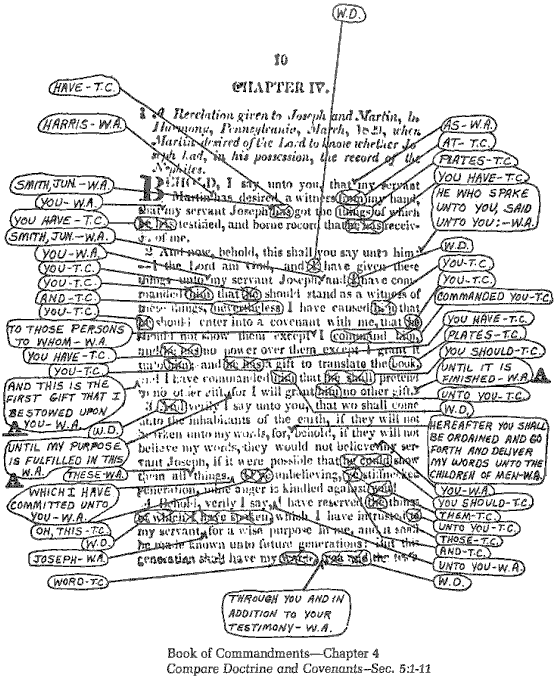
The question has been asked, if the Book of Commandments was true, why did it require such extensive revision just two years later (for its publication as Doctrine and Covenants)? Maybe these revisions are part of the reason why, despite the testimony that God bore record to their souls, at least eight of the Book of Commandment witnesses later abandoned the church that is built on Joseph Smith’s revelations.
———————-
Comments within the parameters of 1 Peter 3:15 are invited.
———————-