
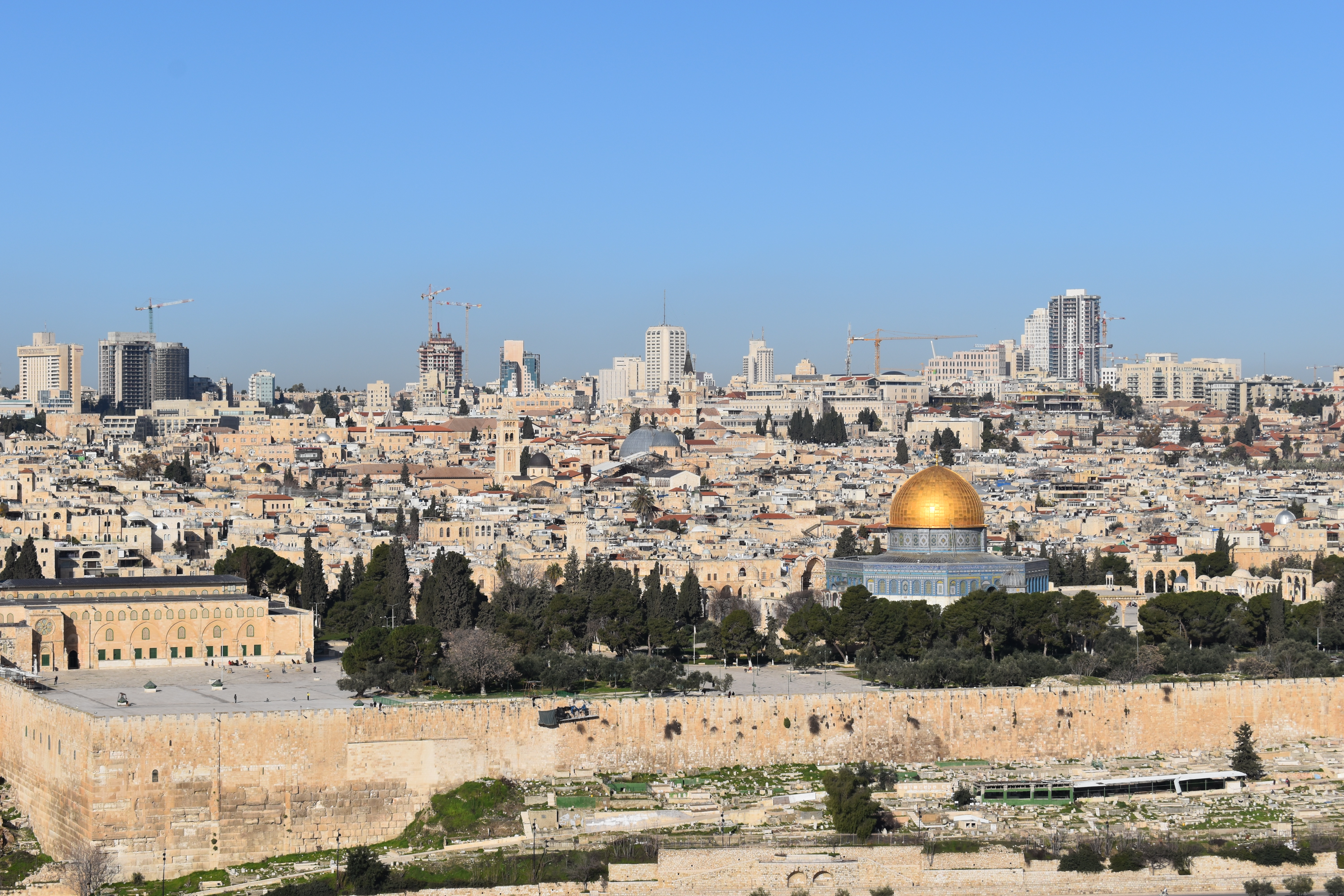
As we head into the Christmas season, one verse in the Book of Mormon that seems like an anomaly is Alma 7:10. It reads,
“And behold, he shall be born of Mary, at Jerusalem which is the land of our forefathers, she being a virgin, a precious and chosen vessel, who shall be overshadowed and conceive by the power of the Holy Ghost, and bring forth a son, yea, even the Son of God.”
While many people even today might assume that Jesus was born in Jerusalem two millenia ago, He was actually born in Bethlehem, a mere six miles away. The minor prophet Micah prophesied in the 8th century BC:
“But you, Bethlehem Ephrathah,
though you are small among the clans of Judah,
out of you will come for me
one who will be ruler over Israel,
whose origins are from of old,
from ancient times.” (Micah 5:2)
Luke 2:4 states that this prophecy came to pass:
“So Joseph also went up from the town of Nazareth in Galilee to Judea, to Bethlehem the town of David, because he belonged to the house and line of David.”
LDS apologists use the mordern-day example of someone saying they were born in Salt Lake City, UT when they really were born in Taylorsville, a suburb city of the Utah capital. In the same way, they argue, the Book of Mormon is correct to say Jesus was born in the “land of Jerusalem.”
To support their case, they say that the Amarna Letters lend credibility to Alma 7:10 and, ultimately, the most sacred of all LDS scriptural books. Is this a good argument?
The Amarna Letters
While many Latter-day Saints (and Christians, for that matter) probably have no clue about what the Amarna Letters are, these were an important archaeological discovery in 1887 at Tell el-Amarna in Egypt. (There is debate as to who actually discovered the tablets—theories range from a woman or group of local farmers.)
The Amarna Letters are made up of 300 clay tablets with cuneiform writing dating to the late 15th/early14th century BC. These were mainly written by rulers north from rulers north of Egypt, with a few composed by Amenhotep IV / Akhenaten.
Amarna Letter EA 287, which has been called “A Very Serious Crime” and has been also given the designation VAT 1644, was written by Abdi-Heba, the ruler of Jerusalem in the 14th century, 400 years before the time of Saul, David, and Solomon. Lines 60-63 read,
“As the king has placed his name in Jerusalem forever, he cannot abandon it—the land of Jerusalem.”
Amarna Letter 290, which was also written by Abdi-Heba, says,
“And now, besides this, a town belonging to Jerusalem, BitdNIN-URTA by name, a city of the king, has gone over to the side of the men of Qiltu.”
Referring to this passage, an unnamed author on FairLatterdaySaints.org explains:
“Thus, the Book of Mormon gets it exactly right — the town of Bethlehem is in the ‘land of Jerusalem.’ In fact, Bethlehem is only 5 miles south of Jerusalem: definitely ‘in the land,’ especially from the perspective of Alma, a continent away.’” Source
The conclusion is made:
“Here Jerusalem is not the city ‘in the land of our forefathers’; it is the land. Christ was born in a village some six miles from the city of Jerusalem; it was not in the city, but it was in what we now know the ancients themselves designated as ‘the land of Jerusalem.’ Such a neat test of authenticity is not often found in ancient documents.”
Of course, one must assume that “BitdNIN-URTA” is a reference to Bethlehem. For the sake of argument, let’s just suppose that this word actually meant “Bethlehem.” Even if that is the case, we must understand the political situation of those writing in Jerusalem during the time 2500 years ago. There were city-states in the political situation during the time of the Amarna Letters.
Joel Kramer, a biblical archaeologist with a YouTube channel titled Expedition Bible, explains,
“Nobody would have used the term ‘land of Jerusalem’ in 83 BC. The reason the term is used in the Amarna Letters is because they date to the time when Canaanite cities were City States. A City State was a major city and the agricultural land surrounding it that belonged to that city.”
Thus, when Alma wrote in 83 BC, it would seem quite odd that the Book of Mormon prophet would have borrowed the system used by the ancient non-Jewish writers in Jerusalem when that particular political system did not continue in history.
Kramer added,
“At the end of the 15th century, beginning of the 14th century BC when the Amarna Letters were written, the Canaanites writing to Pharaoh were City State rulers. This all changed with the Conquest and, once Israel became a kingdom, Jerusalem and Bethlehem were separate cities/towns within the kingdom of Israel and later the kingdom of Judah. In 83 BC Judea was Hellenistic and within twenty years of becoming Roman.”
Certainly the biblical writers never–from the time of the Exodus, Judges, and the Kingdom period through the captivity and all the way thorugh the time of Christ–used “land of” to refer to specific towns in relation to a larger nearby city. Not even once! For the LDS argument to work, the idea needs to have continued beyond the Canaanite culture!
Latter-day Saint apologists are free to try to protect Joseph Smith’s integrity and, with it, the Book of Mormon, even when the evidence goes against them. But when these writers and Instagram videographers attempt to use an archaeological artifact that, in context, does not help their case, it needs to be pointed out.
The Savior Jesus really was born in a specific town called Bethlehem, a minor town in the scope of Israel’s Old Testament geography. Even today, Bethlehem is a minor city. It is not difficult to see how the Bible got it right and the Book of Mormon—composed several thousand years later—contains a mistake that just cannot be reconciled. It might be easier to just admit that the Book of Mormon referenced the wrong city.
NOTE: Bill McKeever details why Alma 7:10 ought to be considered problematic for Latter-day Saints in his article found at https://mrm.org/land-of-jerusalem
For more on the Amarna Letters, check out this video from Joel Kramer.