
The following was first published in the Mormonism Researched in May-June 2025. This is a free publication produced by Mormonism Research Ministry. To get a free subscription of the bimonthly newsletter, visit the website here.
In November 2024, an ex-Mormon posted in the Reddit forum explaining how he/she believed that LDS Church leaders had altered questionable history by deleting two articles in an online edition of a church magazine published more than four decades ago.
A person using the moniker “AngryGargoil” wrote,
“I recently discovered new evidence that the LDS Church is hiding information from its members. I was examining an archived PDF [Portable Document Format] version of the July 1980 Ensign. Contained in the edition is one of the Church’s first publications of the ‘Anthon Transcript,’ a now-proven Mark Hofmann forgery. The church published the new ‘historic’ discovery, with an article written by Mark Hofmann himself. The interesting part? This article is nowhere to be found in the Church’s archived Ensign publications on their website.”
The author added, “This should all come as no surprise to anyone who knows the Church. However, it does speak to their dishonesty.”
Introducing Mark Hofmann
The scrubbed articles on the church’s archived website were originally published on pages 68-73 in the print edition of the July 1980 Ensign—at the time the church’s adult periodical for English speakers. When the articles were deleted is uncertain.
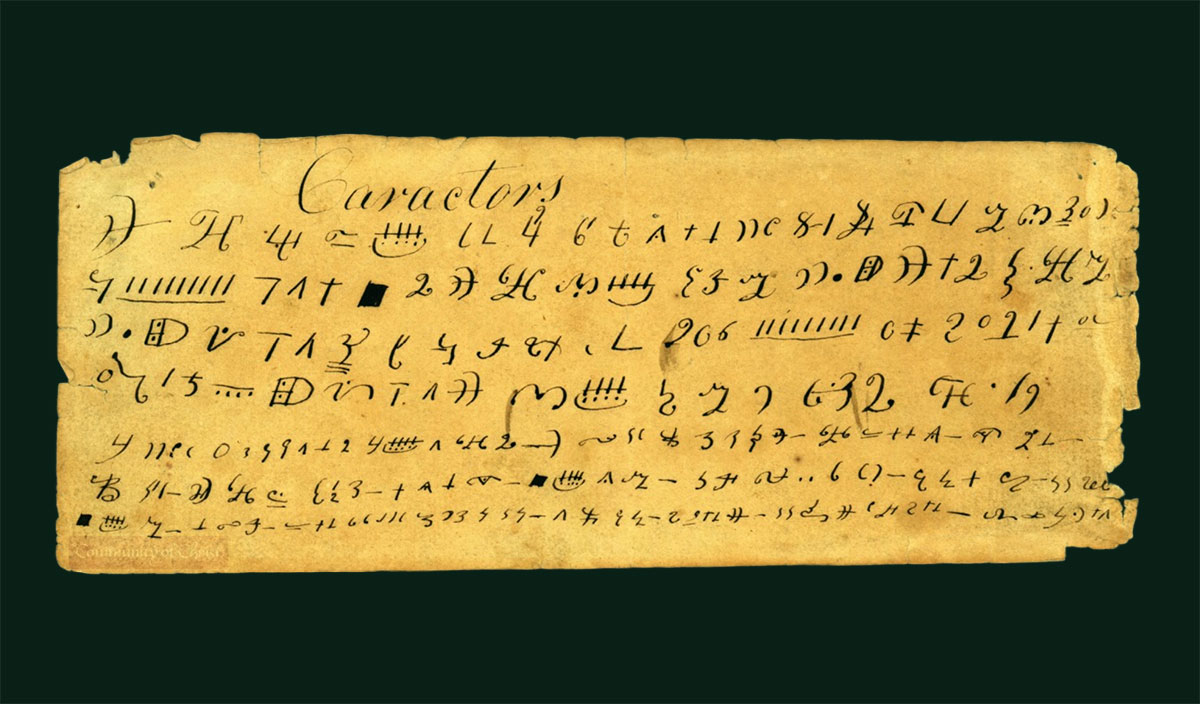
The main article authored by Danel W. Bachman is titled “A Look at the Newly Discovered Joseph Smith Manuscript,” while a shorter story written by “Mark William Hofmann” is called “Finding the Joseph Smith Document.” They describe how Hofmann, a 25-year-old pre-med student at Utah State who identified himself as an “avid collector” of LDS antiquities and books, supposedly discovered the “Anthon Transcript” inside a 17th century Bible that he had purchased in March 1980.
The authentic Bible—published in Cambridge, England, in 1668— “apparently belonged to the Smith family from the late seventeenth century” (Ensign, June 1980, 74; the article titled “Original Copy of Gold Plate Characters Discovered” was also deleted in the online website edition).
The signature of a “Samuel Smith” was written inside the Bible, with historians guessing that he was either the great-grandfather or great-great-grandfather of Joseph Smith. Because the Bible was obtained in the 1950s from a Smith descendant in Carthage, IL (the town where Joseph Smith was killed), Hofmann was hopeful that the handwriting might be genuine.
Referring to the paper found in the Bible, Hofmann explained in his article,
“When I was examining it in my apartment in Logan, Utah, on 16 April 1980, I noticed that two of the pages at the beginning of the book of Proverbs was stuck together about halfway down. . .. After carefully separating the pages, we saw that there was a piece of paper folded in fourths with some black, gluelike substance holding the document together at the folds and sticking it to the pages of the Bible” (Ensign, July 1980, 73. Ellipsis mine).
Hofmann and his wife Doralee were “excited” when they saw what appeared to be the signature of Joseph Smith; Hofmann decided not to unfold the paper because of its potential value and waited until the next day, April 17th, to take it to A.J. Simmonds, curator of the Utah State University Special Collections and Archives.
Hofmann then brought the document to Bachman at Utah State who “studied it for a few minutes and excitedly telephoned Dean Jessee in the Church History Division in Salt Lake City” (Ibid). Bachman, Hofmann, and Jessee met the following day.
On the front side, “Reformed Egyptian” characters believed to have been depicted on the gold plates of the Book of Mormon were copied; similar characters had been published by B.H. Roberts in the first volume of Comprehensive History of the Church.
On the reverse was a letter signed by Joseph Smith, explaining how the document was taken to a Columbia University professor named Dr. Charles Anthon in February 1828. The letter read in part:
“These caractors were dilligently coppied by my own hand from the plates of gold and given to Martin Harris who took them to New York City but the learned could not translate it because the Lord would not open it to them in fulfillment of the prophecy of Isaih written in the 29th chapter and 11th verse” (spelling intact).
The question remained: Could this be the actual document that Harris delivered to the professor in 1828? If real, it would be worth a fortune.
Selling the artifact’s authenticity
According to Bachman, Jessee was the world’s foremost expert in determining the handwriting and signature of Joseph Smith. What Hofmann didn’t tell Jessee (or anyone else, for that matter) is that he had forged the 11×8-inch document on a blank page ripped out of a 19th century library book; he had also created a type of special ink used in the 19th century while writing with a quill pen.
Only Hofmann knew that the folded paper was nothing more than a forgery. This was the perfect ruse, as finding something of such value tucked away in a family Bible is the stuff of legends. Yet a week after they met, Jessee wrote the following to Hofmann: “I have carefully inspected the document. . . and conclude that [it] is a Joseph Smith holograph [hand-written document].”
To pull off the deception, Hofmann needed to be precise in replicating Smith’s handwriting because authentic samples of the church’s founder are readily available. According to Jessee, the misspellings and penmanship were “all characteristic of Joseph Smith.” Boastfully, the church historian stated, “When you have studied a man’s writing like I have Joseph’s, it’s like looking into the face of a man you know well.”
Other convincing characteristics of the document for Jessee were how the misspellings in the document were “all characteristic of Joseph Smith”; there were five columns in the transcript, just as Anthon had reported more than a century before; the Bible was signed by Samuel Smith (though nobody knew what this man’s handwriting looked like, so any signature could work); and the authentic paper and ink was appropriately aged (thanks to Hofmann’s use of a blow dryer).
The church purchased the manuscript for $20,000 and then moved quickly to publicize the discovery. Less than two weeks after the document was first made known, a press conference was held on April 28th. The First Presidency (Spencer W. Kimball, N. Eldon Tanner, and Marion G. Romney) along with apostles Boyd K. Packer and Gordon B. Hinckley joined Hofmann to publicly introduce the manuscript. Despite their “prophetic” ability, the church leaders decided to place their complete confidence in their church historian.
In a famous photo taken at the news conference, Kimball was shown using a magnifying glass to view the piece while the other leaders stood to the sides; meanwhile, Hofmann hovered semi-confidently to the right of the 12th president. The general authorities appeared convinced—hook, line, and sinker!
Perhaps these leaders should have listened to non-Mormon scholar Jan Shipps, who was quoted in a local Utah newspaper published the day after the news conference. Not taking a position of the document’s authenticity, Shipps told the reporter that it was “only the opinion, albeit ‘expert’ of Mr. Jessee that the writing is authentic.” She added that “it should take time to form a consensus” (“Joseph Smith Handwriting and ‘Ancient Characters’?” Salt Lake Tribune, 4/29/1980, B5, italics mine). It appears Shipps—again, she was not LDS—was wiser than the church leaders!
Even though the Anthon Transcript was later proven to be a counterfeit, Hofmann—who grew up Mormon and served an LDS mission but who claimed he was an atheist by the age of 14—dropped out of school to enter the antiquities business. He forged dozens of documents over the next five years, many of which were LDS-related; while some of the purchased LDS documents were made public, others found their way into the church’s secret vault to be hidden away, especially controversial pieces.
Desperate because he felt he might be soon discovered, Hofmann killed two innocent people with bombs on October 15, 1985. The next day he was injured when he accidentally set off a third bomb in his car. Today, Hofmann is serving a life sentence at the Central Utah Correctional Facility, a state prison in Gunnison, Utah.
A “Dishonest” Move?
“AngryGargoil” claimed that the church should be considered “dishonest” for deleting the archived articles in the online issue. However, it should be noted that the PDF versions of the June and July 1980 Ensign magazines are still available on another church website, though not familiar to most members. They can be found in a section called “Church History Catalog,” so technically the articles remain intact.
Still, the PDF files of these issues cannot be accessed by searching on the church’s website; type in “July 1980 Ensign” and you will get the archived online file. The PDF file on the church’s website can only be found by going to a neutral site, archiveviewer.org. In addition, photos of both sides of the Anthon Transcript were printed on the inside front and back covers of the paper magazine, although neither photo is included in the archived edition.
Since the PDF articles are still available on the church’s site, complete with the articles and photos, why did the leaders decide to change the archived editions by deleting the articles? Because the Anthon Transcript is a forgery, it certainly is embarrassing to have the information available to prove how the church leaders were fooled. If hiding the articles is a priority, though, it seems strange to leave the PDF files intact.
Some might argue that deleting factually incorrect material (as the church has done in this instance) is beneficial because future readers will not be fooled by fraudulent information. After all, should a Christian ministry be criticized when it changes or deletes an article from its website if the information has become outdated or is proven to be factually wrong?
The counter argument is that deleting articles in an online church magazine might cause people to wonder what additional articles from other issues have also been taken out. By removing these articles, the church angered people like “AngryGargoil” and others who wrote in the comments section of the Reddit post.
If nothing else, the church’s censorship should remind us that one must be extremely careful when considering the validity of information on the Internet. After all, non-PDF articles are nothing more than “living documents” that can be changed at the poster’s discretion. As it has been said, “Buyer beware.”